Football away days by train: England's rail-linked grounds
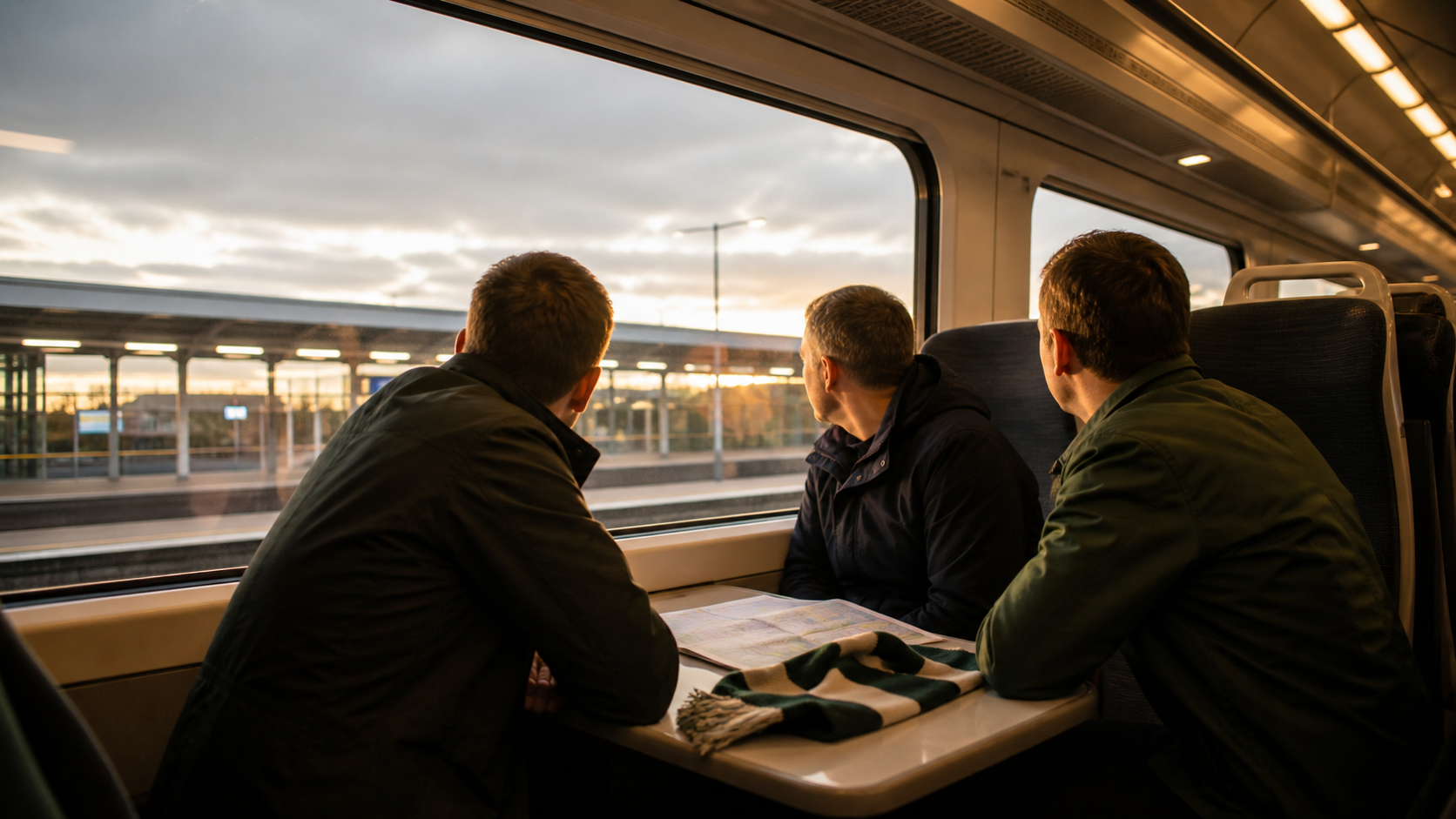
Stop driving to away games
Here is the maths on driving to an away day in 2026: petrol there and back, motorway services because you always stop at motorway services, parking near the ground (if you can find any), and the slow crawl out of a residential area afterwards while stewards wave you in directions you don't want to go. Call it fifty to eighty quid before you've bought a ticket or a pint. And you can't drink, because you're driving home.
The train solves most of this. You can have a few cans on the way there, read the programme on the way back, and avoid the particular misery of the M6 on a Saturday afternoon. If you are still weighing up whether an away day is worth the hassle, read why fans keep going back — the psychology is fascinating. The catch is that not every ground in England is easy to reach by rail. Some are a five-minute walk from the platform. Others involve a two-mile trudge through retail parks and ring roads. This guide separates the two.
The best rail-connected grounds in England
These are the stadiums where the train genuinely works — short walks, frequent services, and no need for a taxi at the other end. Ranked roughly by how easy it is to get from platform to turnstile.
1. Brentford — Gtech Community Stadium
Nearest station: Kew Bridge (South Western Railway) Walk: 3 minutes (about 150 metres)
This is as good as it gets anywhere in England. Kew Bridge station sits practically next to the Gtech Community Stadium, and trains run from London Waterloo every 15 minutes on matchdays. The ground itself opened in 2020 and is one of the best new-build stadiums in the country — tight, loud, and properly designed for football. If you're doing a groundhopping trip around London, Brentford should be first on your list purely for convenience.
2. Arsenal — Emirates Stadium
Nearest station: Arsenal (Piccadilly line) / Finsbury Park (Great Northern, Piccadilly, Victoria) Walk: 3 minutes from Arsenal station, 10 minutes from Finsbury Park
Arsenal tube station is right on the doorstep of the Emirates, but if you're arriving by mainline rail rather than the Underground, Finsbury Park is your stop. Great Northern services from places like Peterborough, Cambridge, and Stevenage drop you ten minutes from the ground. Highbury and Islington is another option on the North London Line — also about ten minutes on foot. The area around the ground has enough pubs to keep you busy beforehand, though the away-fan options are limited.
3. Brighton — Amex Stadium
Nearest station: Falmer (Southern, Great Western Railway) Walk: 5 minutes
Brighton built the Amex right next to Falmer station, and it shows. You step off the train, walk across the car park, and you're there. The nine-minute ride from Brighton mainline station means you can base yourself in the city centre and get to the ground without any hassle. Southern run additional services on matchdays. The only downside is that the station gets absolutely rammed after the final whistle — get out of the ground quickly or accept you're waiting twenty minutes on the platform.
4. Tottenham — Tottenham Hotspur Stadium
Nearest station: White Hart Lane (London Overground) Walk: 5 minutes (about 200 metres)
White Hart Lane station is roughly 500 steps from the Tottenham Hotspur Stadium. The Overground runs frequently and connects to the wider rail network at Highbury and Islington, Liverpool Street, and beyond. Northumberland Park (also Overground) is about ten minutes away on foot and tends to be less crowded. The stadium itself is worth visiting regardless of who's playing — it's the best ground built in England in the last decade, and the food and drink options inside are genuinely good by football standards.
5. Exeter City — St James Park
Nearest station: St James Park (Great Western Railway) Walk: 2 minutes
Exeter City have their own named station, and it's right next to the ground. You can see the floodlights from the platform. Services run from Exeter Central (ten minutes away) and connect to the GWR network from London Paddington, Bristol, and the West Country. The ground itself is a proper old-school football stadium — tight terracing, low stands, and an atmosphere that punches well above its lower-league setting. One of the best away days in the lower leagues.
6. Sheffield United — Bramall Lane
Nearest station: Sheffield (multiple operators) Walk: 12-15 minutes (about 900 metres)
Sheffield station is a major hub served by East Midlands Railway, CrossCountry, Northern, and TransPennine Express, which means you can get there from most cities in England without changing. The walk to Bramall Lane is straightforward — down Sheaf Street and along Shoreham Street, mostly flat. The Blades are in the 2026/27 Championship and the ground retains enough character to feel like a proper football stadium rather than a corporate venue.
7. Portsmouth — Fratton Park
Nearest station: Fratton (South Western Railway, Southern) Walk: 8-10 minutes
Fratton station is about half a mile from Fratton Park. Exit via the footbridge, turn left onto Goldsmith Avenue, and the ground is down Frogmore Road on your left. South Western Railway run direct services from London Waterloo, and Southern connect from Brighton and the south coast. Pompey away is one of the best days out in English football — the atmosphere is consistently brilliant, the city has character, and you can walk to the seafront afterwards. The train home along the coast is a decent way to end the day.
8. Sunderland — Stadium of Light
Nearest station: Stadium of Light Metro / St Peter's Metro Walk: 8-10 minutes from the Metro station
The Stadium of Light has its own Metro station on the Tyne and Wear Metro Green Line. From Sunderland mainline station (served by Grand Central and Northern from London and the North East), you can either walk fifteen minutes directly to the ground or hop on the Metro for one stop to St Peter's and walk eight minutes from there. Sunderland is one of those clubs where the ground is genuinely embedded in the city — the walk from the station takes you through proper streets, not past car parks.
9. Burnley — Turf Moor
Nearest station: Burnley Manchester Road (Northern Trains) Walk: 15 minutes
Burnley Manchester Road is the station you want, not Burnley Central (which is further and served by fewer trains). The walk to Turf Moor is about fifteen minutes along Centenary Way, with the ground visible ahead of you for most of it. Northern Trains run services from Manchester Victoria and Leeds. The away end at Burnley is basic but the atmosphere is raw, and the town centre pubs are cheap by southern standards.
10. West Ham — London Stadium
Nearest station: Pudding Mill Lane (DLR) / Hackney Wick (London Overground) Walk: 10 minutes from either
The London Stadium sits in the Olympic Park, and while it divides opinion as a football ground, it's well-served by public transport. Pudding Mill Lane on the DLR and Hackney Wick on the Overground are both about ten minutes on foot. Stratford International and Stratford mainline are also options, though the walk is slightly longer and involves navigating Westfield. For away fans arriving from outside London, Stratford is the easiest connection — the Elizabeth Line, Greater Anglia, and c2c all stop there.
11. Nottingham Forest — City Ground
Nearest station: Nottingham (East Midlands Railway, CrossCountry) Walk: 20-25 minutes
This one sits on the boundary between "good" and "acceptable" rail access. Nottingham station is a major stop on the Midland Main Line from London St Pancras, which means fast, frequent trains. The walk to the City Ground is about twenty to twenty-five minutes through the city centre and across Trent Bridge — not short, but the route is flat and straightforward. Forest fans will tell you the walk along the river is part of the experience. Buses run from outside the station if your legs disagree.
The worst rail-connected grounds
Not every stadium was built with the train in mind. These are the grounds where the railway lets you down.
Wycombe Wanderers — Adams Park
Nearest station: High Wycombe (Chiltern Railways) Walk: 50+ minutes (2.5 miles)
High Wycombe station is over two and a half miles from Adams Park. Nobody walks this. On matchdays, a Football Special bus (No. 501) runs from the station at 13:55 for Saturday games, costing around 3.50 return — but if you miss it, you're looking at a nine-quid taxi. For a club that's been in the Championship and regularly hosts decent away followings, the transport links are genuinely poor. If you are working through the Championship away days guide, Wycombe is one of the trickiest logistics puzzles. Chiltern Railways services from London Marylebone are fast and frequent, which makes the last-mile problem even more frustrating.
Bournemouth — Vitality Stadium
Nearest station: Pokesdown (South Western Railway) Walk: 15 minutes from Pokesdown, 25-30 minutes from Bournemouth
Neither station is particularly convenient. Pokesdown is closer at about fifteen minutes, but it's a small station with limited services. Bournemouth mainline is better connected but puts you half an hour from the Vitality. For a Premier League club, the rail access is surprisingly awkward. The P2 and P3 buses help, but they add time and uncertainty on a matchday.
Rochdale — Crown Oil Arena
Nearest station: Rochdale (Northern Trains, TransPennine Express) Walk: 30-40 minutes (about 2 miles)
Rochdale station is a solid two miles from the Crown Oil Arena, and the walk takes at least half an hour through the town. The 468 bus runs from Rochdale Interchange and takes about thirteen minutes, but the frequency isn't great. For lower-league groundhoppers, this is one of the more annoying trips — the train connection from Manchester is fine, but the last mile is a slog.
Leicester City — King Power Stadium
Nearest station: Leicester (East Midlands Railway, CrossCountry) Walk: 25-30 minutes (1.2-1.5 miles)
Leicester station is well-served by fast trains from London St Pancras, Sheffield, and Nottingham. The problem is the walk to the King Power — it's over a mile through the city and takes the best part of half an hour. Not terrible in good weather, but on a wet Tuesday night in November it feels a lot further. A walking route is signposted from the station, which at least stops you getting lost.
How to save money on rail tickets
Train travel in England is expensive if you do it wrong and surprisingly affordable if you know the tricks. Here's what actually works.
Book Advance tickets early
If you want a full breakdown of how to see multiple grounds without breaking the bank, the groundhopping on a budget guide covers a ten-stadium European itinerary for under five hundred pounds. For domestic trips, this is the single biggest saving. Advance fares go on sale up to twelve weeks before the travel date, and the cheapest ones sell out fast. A London to Manchester Advance single can be as low as twelve to fifteen pounds. The same journey on the day, buying an Anytime ticket, can be sixty or seventy. The trade-off is that you're locked to a specific train — if it's cancelled, you can usually travel on the next available service, but you can't just turn up whenever you fancy.
For matchday travel, book as soon as fixtures are confirmed and kick-off times are set. A moved fixture (Saturday to Sunday, 3pm to 5:30pm) can wreck your Advance booking, so keep an eye on TV selections.
Get a Railcard
A 16-25 Railcard or 26-30 Railcard costs thirty pounds a year and gives you a third off most tickets. The Two Together Railcard does the same for two people travelling together — useful if you always go to games with the same mate. Over a season of away days, these pay for themselves within two or three trips.
Railcard discounts stack with Advance fares, which is where the real savings happen. A fifteen-quid Advance becomes a tenner. Over a full season, that adds up to hundreds.
Split ticketing
This is legal, widely used, and genuinely effective. Instead of buying a single ticket from A to B, you buy two or more tickets covering different legs of the same journey. The train doesn't need to stop at the split point — you just need to pass through that station. Apps like Trainsplit and Split My Fare find the cheapest splits automatically. Savings of 30 per cent are common, and occasionally you'll find splits that cut the price in half.
The key thing: you stay on the same train. You don't need to get off and change. You just hold multiple tickets for different portions of the route.
Travel off-peak
Off-peak and super off-peak tickets are significantly cheaper than peak fares. For Saturday 3pm kick-offs, you're usually in off-peak territory anyway. Midweek evening games are trickier — the outbound journey often falls in peak hours. If you can leave slightly earlier (before 4pm or after 7pm depending on the operator), you'll dodge the peak premium.
GroupSave
If you're travelling with two or more mates, GroupSave offers up to 34 per cent off on many routes. You need at least three passengers travelling together, and it only works on off-peak services, but for a group heading to an away game it's an easy saving that most people don't know about.
Matchday logistics: the stuff that catches people out
When to arrive
Aim to be at the ground an hour before kick-off. Not because you need an hour to find your seat, but because the pubs near away ends fill up fast, the queues for food and drink inside the ground can be long, and arriving stressed and rushing isn't the way to enjoy an away day. If you're visiting a new ground for the first time, give yourself time to walk around it and take it in.
The last train home
This is where away days go wrong. A Saturday 3pm kick-off finishes around 4:50pm. At most grounds outside London, the last sensible train home leaves between 6pm and 8pm depending on where you're heading. That sounds like plenty of time, but add in the walk from the ground to the station, the crowd at the station, and any delay to the train itself, and the margin shrinks fast.
For televised matches with later kick-offs — 5:30pm Saturday, 4pm Sunday, 8pm midweek — the last train situation becomes genuinely difficult. An 8pm weeknight kick-off finishes at 9:50pm. If you're two or three hours from home by rail, there may not be a train. Check the last departure time before you book your matchday ticket.
If the last train is tight, have a backup plan. A pre-booked coach (National Express, Megabus) often runs later than trains. A hotel room booked on the day via an app is sometimes cheaper than you'd expect, especially in northern cities midweek. Splitting a taxi to the nearest larger station can work if the local service stops early but mainline trains run later.
Engineering works
Sunday matches and bank holiday fixtures are the danger zone. Network Rail schedules most of its track maintenance on Sundays, and replacement bus services can double or triple your journey time. Always check National Rail's journey planner the week before — if there are engineering works on your route, you'll see it flagged. This catches people out more than anything else.
Matchday extras on the train
Some operators run additional services on matchdays. Southern add extra trains to Falmer for Brighton games. South Western Railway increase frequency to Kew Bridge for Brentford. These don't always appear in the timetable until a week or two before, so check again closer to the date even if it looked thin when you first searched.
Building your railway away day record
Part of the appeal of doing away days by train is the ritual of it — the same platform, the same pre-match pint near the station, the slow accumulation of grounds ticked off. If you're working through the 92 Club or just keeping a record of every ground you visit, the train makes each trip feel like a proper journey rather than a motorway commute. For separate-day combinations, use the six EFL weekend route shapes instead of trying to improvise a same-day double.
Footbeen lets you log every match you attend and track the stadiums, cities, and countries you've visited — building a map of your football life over time. Whether you're doing two away days a season or twenty, having that record to look back on makes the whole thing more satisfying.
The best away days aren't the ones where everything goes smoothly. They're the ones with a story — the wrong train, the sprint from the station, the last-minute equaliser that made the whole trip worth it. The train puts you in the middle of all of it.
Season reference: EFL Championship fixtures; a current division does not verify a bus timetable or fare.
Keep reading

Keep your football journey in Footbeen
Log the matches you attend, save every stadium and build a record that grows with every trip.
 Scan with your phone