Non-league groundhopping: why the lower pyramid is the real experience
The choice nobody talks about
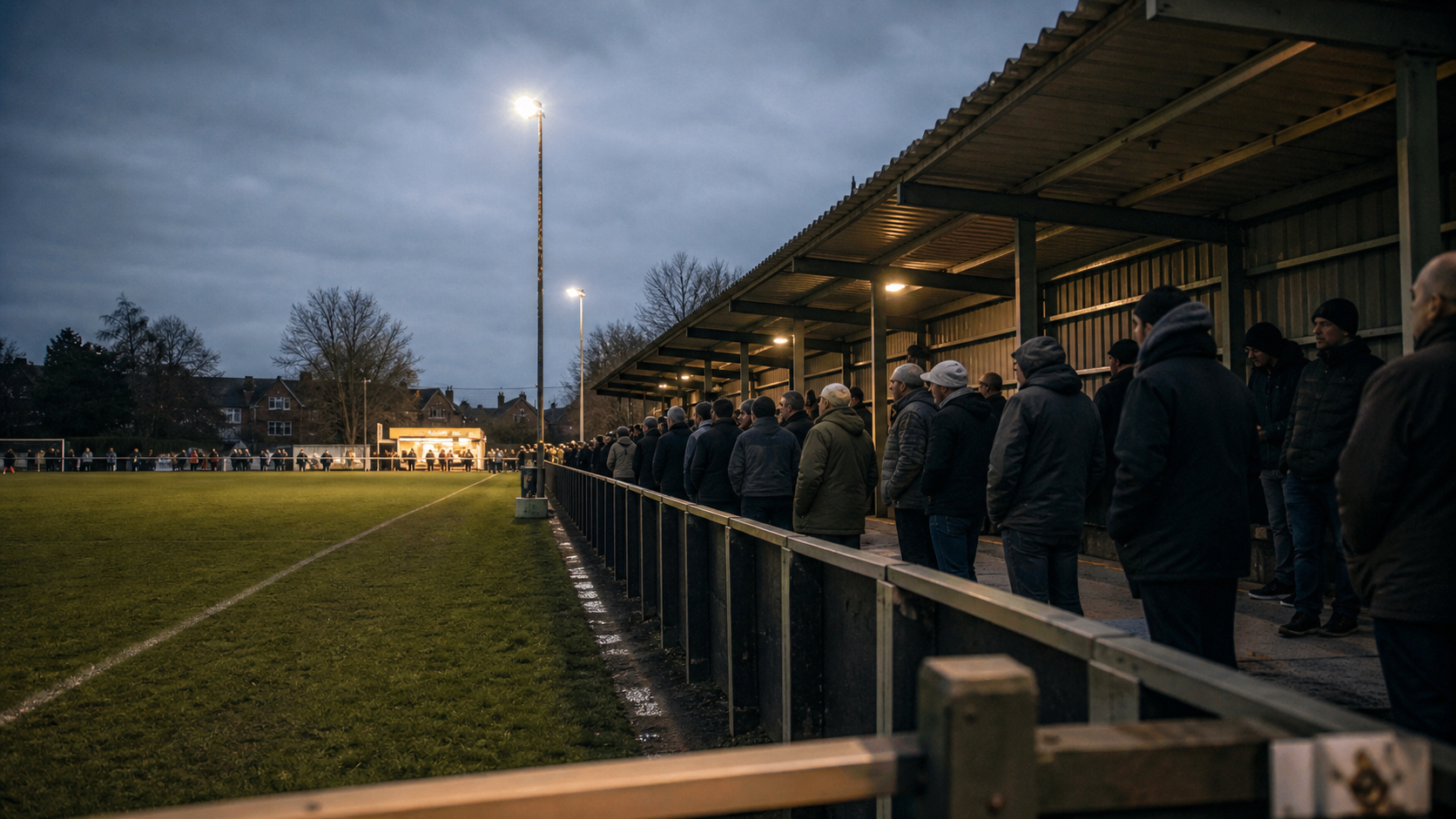
Top-flight and non-league football offer different versions of a matchday. A Premier League trip can be a major event with a large stadium, tight ticket demand and a long journey. At a lower-pyramid ground, the scale is usually smaller: you may stand close to the pitch, meet people who run the club, and decide to go with far less ceremony.
For a groundhopper, that is not a lesser experience. The close view, local routine and variety of older terraces make a National League or regional-league match feel immediately personal. A familiar Saturday can become a new ground, a new town and a match you remember for reasons beyond the score.
Prices, ticket access and facilities vary by club and fixture, so treat any one ground as its own plan. The attraction of the lower pyramid is that it gives fans more routes into live football: community clubs, distinctive venues and a matchday that rewards curiosity.
The rest of this guide explains what to expect, how the pyramid works and which grounds make a strong first trip.
What counts as "non-league"
The term is a holdover from before the National League existed. Technically, "non-league" means any club outside the 92 that make up the Premier League, Championship, League One, and League Two. In practice, groundhoppers use it to describe everything from the National League (tier 5) downwards. For a focused first step into that top tier, use the National League groundhopping guide.
Here's how the pyramid works below League Two:
Tier 5 — National League. 24 clubs. This is the top of non-league football and the gateway to the EFL. Source-backed pages such as Sutton Utd and Barrow are useful starting points for planning. Most squads are full-time or close to it. Crowds regularly hit 3,000-5,000. Two clubs go up each season — the champions automatically, and one through the play-offs.
Tier 6 — National League North and National League South. Two parallel divisions of 24 clubs each, split geographically. This is where full-time and semi-professional football properly blur. You'll find clubs with deep histories that have fallen through the leagues alongside ambitious newcomers climbing fast. Dorking Wanderers, for instance, were in the Combined Counties League as recently as 2014 and are now established in the National League South.
Tier 7 — the regional leagues. The Northern Premier League Premier Division, the Southern League Premier Division (Central and South), and the Isthmian League Premier Division. Three parallel divisions covering different parts of the country. This is overwhelmingly semi-professional football. Players have day jobs. Managers are part-time. The football is still competitive and often surprisingly good.
Tier 8 and below. The Northern Premier League Division One (West, East, Midlands), the Southern League Division One (Central, South), and the Isthmian League Division One (North, South). Below that, county leagues, and eventually Sunday league football in public parks.
The pyramid is deep. There are over 800 clubs in the National League System alone, spread across tiers 5 to 10. Every single one has a ground, a matchday routine, and a community around it.
Why groundhoppers prefer it
The 92 Club gets the attention, but ask any serious groundhopper what they actually enjoy more — a League Two match or a National League North match — and the answer is almost always the lower league. Here's why.
You can walk up and pay on the gate
No membership schemes. No presale windows. No Ticketmaster fees. At the vast majority of non-league grounds, you turn up 20 minutes before kick-off, hand over cash or tap your card at the turnstile, and you're in. At Horsham in the Isthmian League Premier Division, adult admission is £15. At FC United of Manchester in the Northern Premier League, it's £15. At Dulwich Hamlet in the Isthmian League Premier Division, it's around £14.
Compare that with a Premier League match where you need a membership, a ballot result, a second mortgage, and three months of planning. Non-league respects the idea that football should be something you can decide to watch on a Saturday morning and actually go and do that afternoon.
You're close to the pitch
At most non-league grounds, the front of the terrace is two or three metres from the touchline. You can hear the centre-half calling for the ball. You can see the winger's face when he knows he's beaten his man. You can watch the manager's body language shift in real time when a substitution goes wrong.
This proximity changes how football feels. It stops being a spectacle viewed from a distance and starts being something you're physically part of. The sound is different too — at a 2,000-capacity ground, a crowd of 800 makes more noise than 40,000 spread across a bowl.
Every ground is different
The Premier League has spent two decades building identical all-seater bowls. The Amex, the Tottenham Hotspur Stadium, the Emirates — they're architecturally impressive and atmospherically dead. You could blindfold someone and drop them in any of them and they wouldn't know which city they were in.
Non-league grounds are the opposite. One end might be a covered terrace from the 1920s. The other end might be a grass bank. The main stand might seat 200. There might be a tree growing behind the goal. The club bar might double as the boardroom. No two grounds feel the same, because no two grounds were built to the same corporate specification.
The food is actually good
Premier League stadium catering is a cartel. The same suppliers, the same reheated pies, the same £5.50 bovril. Non-league clubs either run their own kitchen or have a local burger van on site, and the difference is stark. A bacon roll and a cup of tea for £4 at a non-league ground will be better than anything you've ever eaten at a Premier League match. This is not an exaggeration.
You can talk to players
After a non-league match, the players walk through the same exit as the fans. They drink in the same bar. If you want to tell the striker his first touch was excellent, you can do that. Try doing that at the Etihad.
The cost of a season
A full season of non-league away days — say, 20 matches — might cost you £300 in admission. A single Premier League away day can cost more than that once you factor in the ticket, the train, and the hotel. For more on keeping costs down, see our groundhopping on a budget guide. The maths is not complicated.
The best non-league grounds to visit first
If you are nervous about attending a match at an unfamiliar ground by yourself, our first away day guide covers everything from finding the pub to surviving the journey home. If you're new to non-league groundhopping, these are the grounds that will convert you. Each one is a genuine recommendation — a place where the football is worth watching and the ground itself is worth the trip.
Gigg Lane — Bury FC
Capacity: 11,840 | Tier 8 (Northern Premier League Division One West, 2025/26) | Built: 1885
Bury FC were expelled from the Football League in 2019 after 125 years of membership. The club reformed, re-entered at the tenth tier, and started climbing back. In April 2026, they won the NPL Division One West title and secured promotion to the NPL Premier Division.
What makes Gigg Lane special is the contrast. This is an 11,840-capacity ground hosting eighth-tier football. The infrastructure is from a different era — proper stands, floodlights, a ground that was built for Football League crowds. Bury are averaging over 3,500 per home league match, which is extraordinary for the eighth tier and higher than some National League clubs manage. The atmosphere is driven by a fanbase that had its club taken away and fought to get it back. Going to Gigg Lane right now is watching a resurrection in real time.
Champion Hill — Dulwich Hamlet
Capacity: 3,334 | Tier 7 (Isthmian League Premier Division, 2025/26)
Dulwich Hamlet are the hipster's non-league club, and that reputation is both earned and slightly unfair. Yes, the crowd skews young. Yes, there's craft beer. But Dulwich Hamlet also have a genuine community around them that goes beyond trend — the club has been in South London since 1893 and has survived multiple existential crises over ground ownership.
Champion Hill itself is compact and atmospheric. Adult admission is around £14. The ground is a 15-minute walk from East Dulwich station, which makes it one of the most accessible non-league grounds in London. The club have planning permission for a new 4,000-capacity stadium on the adjacent site, so the current Champion Hill won't be around forever. Visit it while you can.
Broadhurst Park — FC United of Manchester
Capacity: 4,400 | Tier 7 (Northern Premier League Premier Division, 2025/26) | Built: 2015
FC United were founded in 2005 by Manchester United supporters who opposed the Glazer takeover. They built Broadhurst Park from scratch — a community-owned, purpose-built ground in Moston, north Manchester. Adult matchday admission is £15, with concessions at £10.50 and under-18s just £3.
The ground is modern but doesn't feel corporate. The standing terrace behind the goal is where the atmosphere concentrates. FC United's entire existence is a statement about what football should be — fan-owned, affordable, rooted in its community. Whether you agree with the politics or not, the matchday experience is excellent. The club bar is worth arriving early for.
The Dripping Pan — Lewes FC
Capacity: 3,000 | Tier 7 (Isthmian League Premier Division, 2025/26) | In use since: 1885
The name alone is worth the trip. The Dripping Pan sits in a natural hollow beneath Lewes Castle in East Sussex, and it's one of the most beautiful settings for a football ground anywhere in England. The town itself is worth a visit — narrow streets, independent shops, a brewery within walking distance of the ground.
Lewes FC are notable for being the first professional or semi-professional club in the world to pay their women's team equally to their men's team. The women's team plays in the FA Women's National League South. Both teams play at The Dripping Pan, and the atmosphere is welcoming in a way that some clubs — at any level — never manage.
The stands are modest: the Philcox Terrace, the Rookery Stand, the Ham Lane End. None of them hold more than a few hundred. That's the point. At The Dripping Pan, you're watching football the way it was watched a century ago, in a setting that hasn't been bulldozed and rebuilt.
The Home of Football — Sheffield FC
Capacity: approximately 2,000 (current ground) | Tier 9 (Northern Counties East League Premier Division, 2025/26) | Club founded: 1857
Sheffield FC are the oldest football club in the world. Not the oldest professional club (that's Notts County). Not the oldest league club. The oldest club, full stop. Founded on 24 October 1857, recognised by FIFA, and still playing competitive football 169 years later.
Their current ground — aptly named The Home of Football — has two covered stands and a capacity of around 2,000. The club have been developing plans for a new 5,000-seater stadium at Meadowhead, designed to meet Football League and Super League standards, though timelines have shifted. For now, the existing ground is where you need to go.
Sheffield FC were relegated from the Northern Premier League and currently play in the Northern Counties East League Premier Division — the ninth tier. The football is honest, the history is unmatched, and the experience of watching the oldest club in the world play on a Saturday afternoon is something you can't replicate anywhere else on earth.
Meadow Lane — Notts County
Capacity: 19,841 | Tier 5 (National League, 2026/27) | Built: 1910
Notts County are the oldest professional football club in the world, founded in 1862. They were one of the 12 founding members of the Football League in 1888. Meadow Lane has been their home since 1910 and sits directly across the River Trent from Nottingham Forest's City Ground — the two grounds are closer together than any other pair in English football.
Notts County are a 2026/27 League One club following their 3-0 play-off final win, rather than a current non-league option, but Notts County belong in this list because they embody the spirit of lower-league football. The ground is a proper old-fashioned football stadium with four distinct stands, 19,841 seats, and typical crowds well below capacity. It feels vast and historic in a way that modern grounds never will. If you're working on the 92 Club and doing the lower-league grounds first, Meadow Lane should be near the top of your list.
Gander Green Lane — Sutton United
Capacity: 5,013 | Tier 5 (National League, 2025/26)
Sutton United's VBS Community Stadium — still universally known as Gander Green Lane — is in suburban south London, and it looks like a non-league ground that accidentally ended up hosting Football League matches for two seasons (which is exactly what happened, when Sutton were in League Two from 2022 to 2024).
The ground has a famously cramped main stand, a covered terrace, open standing areas, and a clubhouse that does a decent pint. Sutton's FA Cup heritage is part of the draw — the 1989 giant-killing of Coventry City happened here. The ground has been modernised in places to meet EFL standards but retains the character of a non-league venue. Adult admission in the National League is typically around £18-20 on the gate.
The EnviroVent Stadium — Harrogate Town
Capacity: 5,000 (2,000 seated) | Tier 5 (National League, 2026/27)
Harrogate are a 2026/27 National League club, as listed in the FA’s season allocations. Their 2020 EFL promotion is part of the club’s history; Wetherby Road is now a fifth-tier visit. The EnviroVent Stadium on Wetherby Road has 5,000 capacity with 2,000 seats and 3,000 standing. The away terrace runs about two-thirds of the pitch length. It's small, it's basic, and it's absolutely worth visiting because it's proof that non-league clubs can make the jump without losing their identity.
Harrogate itself is a pleasant town to spend a Saturday in before the match. The ground is walkable from the town centre. If you're doing a Yorkshire groundhopping weekend — Harrogate, Bradford, Huddersfield — this is a logical stop.
Practical tips for your first non-league match
Finding fixtures
This is the biggest barrier to entry. Non-league fixtures don't appear on Sky Sports or the BBC football pages (at least not reliably below the National League). You need dedicated sources:
- Club websites are the most reliable. Find the club, find their fixture list, check the kick-off time. Most non-league clubs maintain their own website through Pitchero.
- NonLeague Matters (nonleaguematters.co.uk) has fixtures, results, and tables from the National League down to county level.
- The Non League App and NonLeague Live on Android and iOS give real-time scores and fixture lists for lower-tier football.
- Twitter/X is still the fastest way to find out if a match has been postponed. Follow the club's account. Non-league pitches get waterlogged regularly, and you don't want to drive two hours to find out the match is off.
Kick-off times
Saturday matches kick off at 3pm, same as the rest of English football. Midweek matches are typically 7:45pm. Some clubs at tier 7 and below play on Saturday mornings or early afternoons to avoid clashing with nearby EFL clubs. Always check.
What to expect on arrival
Most non-league grounds have a single entrance or a small number of turnstiles. You queue, you pay, you walk in. Some clubs now accept card payments at the gate; others are still cash-only. Bring a tenner and some coins just in case.
There will be a programme — usually £2-3, always worth buying. There will be a tea bar or a burger van. There will probably be a club bar that opens before and after the match, and often at half-time. Non-league club bars are a social institution. Use them.
Standing vs seating
The majority of non-league grounds are predominantly standing. Some have a small main stand with seats — often 100-300 — and the rest is open or covered terracing. If you want a seat, arrive early. If you want atmosphere, stand behind the goal with the home fans. Nobody will stop you moving around the ground during the match, which is one of the great unsung freedoms of non-league football.
Getting there
Parking is usually free or cheap — a field next to the ground, a nearby street. Train connections vary wildly. London clubs (Dulwich Hamlet, Sutton United) are easy by rail. Rural clubs may require a car. Check the club website's "Getting Here" page; most non-league clubs are good about providing directions because they know their ground isn't on Google Maps' radar.
The weather
Non-league football runs from August to April. There is no heated concourse. There is no retractable roof. Dress for standing outdoors for two hours in whatever the English weather decides to throw at you. Layers, waterproof jacket, decent shoes. The fans who come every week will be wearing the same thing they've worn for twenty years. Nobody is judging your outfit.
The non-league calendar
A few dates worth knowing:
Non-League Day is held annually to encourage fans of top-flight clubs to attend a non-league match during an international break. The 2026 edition took place on 28 March; that date is past and is not a current event invitation. It's a good excuse to go for the first time, but honestly, any Saturday works.
The FA Cup first and second qualifying rounds (August-September) are when non-league clubs enter the competition. The early rounds are played at non-league grounds and the potential for upsets — and the matchday buzz that comes with cup football — makes these fixtures worth seeking out.
The FA Trophy and FA Vase are the non-league equivalents of the FA Cup. The Trophy is for clubs at tiers 5-8; the Vase is for tiers 9-11. Both competitions are knockout, both produce memorable days out, and both finals are played at Wembley.
Tracking your non-league journey
One of the frustrations of non-league groundhopping is that most football apps don't cover it. The big platforms stop at the National League, if they go that far.
Footbeen covers League Two, the National League, and leagues across the English pyramid — log your non-league matches the same way you'd log a Champions League night. Every ground goes on your personal map. Every match adds to your stats. If you're building a list of grounds visited below the 92, having them all in one place alongside your top-flight visits is the only way to see the full picture.
Start anywhere
The best piece of advice for non-league groundhopping is the simplest: go to your nearest non-league ground on Saturday. Don't overthink it. Don't plan a route. Don't wait for the perfect fixture. Just pick the closest club to your house that's playing at home this weekend, walk up, pay your money, and watch the match.
You'll spend less than £20. You'll be home by 5:30pm. And there's a very good chance you'll be looking up the next fixture before you've even taken your coat off.
Season references: Barrow’s National League fixtures, Rochdale’s League Two fixtures and Notts County’s promotion final report. York and Rochdale are EFL clubs in 2026/27, not current fifth-tier examples.
Current pyramid reference: the FA’s 2026/27 National League System allocations.
Keep reading

Start your football journey
Free · iOS & Android · match search ready when you are
 Scan with your phone