European groundhopping: 10 weekend routes with 2+ stadiums per trip
The weekend groundhopping principle
A single stadium justifies a trip. Two stadiums in the same weekend turns a trip into a proper groundhopping run. Three stadiums and you are building a collection at pace.
The logic is simple: if you are already paying for a flight and a hotel, adding a second or third match to the itinerary costs almost nothing extra. A Friday night match, a Saturday 3pm kick-off, and a Sunday afternoon game can all fit within a standard weekend. European football's fixture scheduling — with matches spread across Friday, Saturday, and Sunday — makes this not just possible but easy if you pick the right cities.
What follows are ten weekend routes across Europe, each covering two or three stadiums within a realistic Friday-evening-to-Sunday-night window. Every route includes specific stadiums, realistic ticket prices, transport between grounds, and an estimated total budget. Some routes are famous. Others are routes you would not think of unless someone pointed them out. All of them work.
One note on prices: all figures are based on 2025-26 season costs, booking flights 4-8 weeks in advance, and staying in budget hotels or hostels. Prices fluctuate. The budgets are realistic, not optimistic.
Route 1: The Ruhr Derby Run — Dortmund and Gelsenkirchen
Stadiums: Signal Iduna Park (Dortmund) + Veltins-Arena (Gelsenkirchen) Country: Germany League: Bundesliga
Two of the fiercest rivals in European football, 30 kilometres apart. The Revierderby between Borussia Dortmund and Schalke 04 is one of the most intense fixtures on the continent, but even without the derby itself, catching both clubs on the same weekend is straightforward. Dortmund typically play on Saturday, Schalke on Sunday (or vice versa), and the S-Bahn between the two cities takes 25 minutes.
Getting there: Budget flights to Dortmund Airport from most European cities: £25-50 return on Ryanair or Wizz Air. Alternatively, fly to Dusseldorf and take the train (70 minutes to Dortmund, 30 minutes to Gelsenkirchen).
Tickets: Standing at Signal Iduna Park: 15-20 EUR. The Sudtribune is 25,000 people in a single terrace and remains the greatest standing section in world football. Veltins-Arena: 15-25 EUR for standing, 30-50 EUR seated. Both clubs sell to non-members for most fixtures.
Transport between grounds: The Deutschlandticket costs EUR 63 per month in 2026 and EUR 66.80 from 1 January 2027. It is a subscription covering participating local and regional transport, not ICE or IC/EC trains; check cancellation conditions before buying it for a weekend. The S1 line connects Dortmund Hauptbahnhof to Gelsenkirchen in under 30 minutes.
Accommodation: Budget hotel in Dortmund: 50-70 EUR per night. Hostel: 20-30 EUR.
| Category | Cost |
|---|---|
| Return flight | £25-50 |
| Accommodation (2 nights) | £80-120 |
| Match tickets (2 matches) | £25-40 |
| Transport (Deutschlandticket subscription) | EUR 63 in 2026; EUR 66.80 from 1 January 2027 |
| Food and drink | £40-60 |
| Total excluding the transport subscription | £170-270, plus the EUR ticket price above |
The Ruhr Valley is the cheapest serious groundhopping weekend in Europe. Two Bundesliga stadiums, two world-class atmospheres, for the price of a single Premier League ticket at some grounds. For more on German football travel, see the complete Bundesliga away days guide.
Route 2: The Milan Double — San Siro and Beyond
Stadiums: San Siro (Milan) + Gewiss Stadium (Bergamo) or Stadio Renato Dall'Ara (Bologna) Country: Italy League: Serie A
San Siro is shared by AC Milan and Inter, which means on most weekends at least one of them plays at home. The other match comes from Bergamo — home of Atalanta, one of the most exciting teams in European football — which is 50 minutes from Milan by train. Alternatively, Bologna is an hour by high-speed rail and has a passionate fanbase in a city that rivals anywhere in Italy for food and atmosphere.
Getting there: Budget flights to Milan Bergamo (Ryanair's hub) or Milan Malpensa: £30-70 return. Bergamo Airport is actually closer to Atalanta's ground than to central Milan, which makes the logistics even easier if you start in Bergamo.
Tickets: San Siro: 20-50 EUR for Serie A depending on the stand and fixture. The third tier (terzo anello) is the cheapest and offers a vertigo-inducing view of the pitch from an absurd height. Gewiss Stadium: 15-30 EUR. Dall'Ara in Bologna: 15-35 EUR.
Transport between grounds: Milan to Bergamo: regional train, 5-8 EUR, 50 minutes. Milan to Bologna: Italo or Trenitalia high-speed, 15-30 EUR booked in advance, 65 minutes.
| Category | Cost |
|---|---|
| Return flight | £30-70 |
| Accommodation (2 nights) | £70-120 |
| Match tickets (2 matches) | £35-70 |
| Transport | £15-30 |
| Food and drink | £50-70 |
| Total | £200-360 |
San Siro alone is worth the trip — the external towers, the steep terracing, the noise from the Curva — but adding Bergamo or Bologna turns a single-match visit into a proper Italian football weekend. The Serie A stadium guide covers every ground worth visiting across the league.
Route 3: The Randstad Triple — Amsterdam, Rotterdam, and Utrecht
Stadiums: Johan Cruyff Arena (Amsterdam) + De Kuip (Rotterdam) + Stadion Galgenwaard (Utrecht) Country: Netherlands League: Eredivisie
The Netherlands is a groundhopper's dream because of geography. Amsterdam, Rotterdam, and Utrecht form a compact rail triangle where the cities are close enough to plan a realistic football weekend. Ajax, Feyenoord, and FC Utrecht regularly play on different days of the weekend, and Dutch Railways (NS) runs frequent services between all three.
Getting there: Budget flights to Amsterdam Schiphol: £30-60 return. Schiphol is 15 minutes by train from Amsterdam Centraal and 45 minutes from Rotterdam.
Tickets: Johan Cruyff Arena: 20-40 EUR for most Eredivisie fixtures. De Kuip: 20-35 EUR — and this is the stadium to prioritise. De Kuip's atmosphere is legendary, the steep bowl amplifies noise beyond what the 47,000 capacity suggests, and Feyenoord fans are among the most passionate in Europe. Galgenwaard: 15-25 EUR.
Transport between grounds: NS day return tickets between any two of these cities: 10-18 EUR each. Or buy an OV-dagkaart (day pass) for around 45 EUR and travel unlimited across the Dutch rail network.
| Category | Cost |
|---|---|
| Return flight | £30-60 |
| Accommodation (2 nights) | £90-140 |
| Match tickets (2-3 matches) | £50-90 |
| Transport | £25-45 |
| Food and drink | £50-70 |
| Total | £245-405 |
The biggest challenge is fixture scheduling. Check the Eredivisie fixture list carefully — Dutch matches are spread across Friday evening, Saturday afternoon, Saturday evening, and Sunday. With the right fixtures, three stadiums in a single weekend is entirely realistic.
Route 4: The Istanbul Divide — Europe and Asia in One Weekend
Stadiums: Rams Park (Istanbul) + Sukru Saracoglu Stadium (Istanbul) + Inonu Stadium/Tupras Stadium (Istanbul) Country: Turkey League: Super Lig
Istanbul has three massive clubs — Galatasaray, Fenerbahce, and Besiktas — and on any given weekend, at least two of them play at home. The city straddles two continents, the ticket prices are low, and the atmospheres are among the most intimidating in world football. This is not a weekend for neutrals who want a quiet sit-down.
Getting there: Budget flights to Istanbul Sabiha Gokcen or Istanbul Airport: £40-80 return. Turkish low-cost carriers (Pegasus) and Ryanair serve both airports from across Europe.
Tickets: Regular Super Lig fixtures can be good value compared with western European headline games, but Istanbul derbies and European nights are a different market. Check the club's official ticket route before assuming a neutral-friendly sale.
Transport between grounds: Istanbul's metro and Marmaray rail tunnel connect the European and Asian sides. Galatasaray's Rams Park is on the European side (metro to Seyrantepe), Fenerbahce's ground is on the Asian side (metro to Sogutlucesme), and Besiktas sit right on the Bosphorus (tram/funicular to Kabatas). An Istanbulkart travel card covers everything; fares are negligible.
| Category | Cost |
|---|---|
| Return flight | £40-80 |
| Accommodation (2 nights) | £40-70 |
| Match tickets (2 matches) | £10-30 |
| Transport | £5-10 |
| Food and drink | £30-50 |
| Total | £125-240 |
Istanbul is the cheapest route on this list and arguably the most intense. The football culture is all-consuming — entire neighbourhoods are painted in club colours, match days take over the city, and the noise inside the stadiums is on a level that most Western European grounds cannot touch.
Route 5: The Madrid Double — Bernabeu and Metropolitano
Stadiums: Santiago Bernabeu (Madrid) + Civitas Metropolitano (Madrid) Country: Spain League: La Liga
Two of the best stadiums in Europe, in the same city, often hosting matches on consecutive days. Real Madrid typically play on Saturday evening, Atletico Madrid on Sunday, or vice versa. The Bernabeu's recent renovation has made it the most technologically advanced ground in Spain — retractable roof, 360-degree screen, underground pitch storage. The Metropolitano is a 70,000-seat modern bowl with an atmosphere driven by Atletico's ultras in the Fondo Sur.
Getting there: Budget flights to Madrid Barajas: £30-70 return. Madrid is well-served by every budget airline in Europe.
Tickets: Bernabeu: 40-80 EUR for most La Liga fixtures. Atletico: 30-60 EUR. Both clubs sell through their websites; non-member general sale opens 2-3 weeks before each match. Derby and Champions League fixtures are significantly harder and more expensive.
Transport between grounds: Madrid Metro. Single journey: 1.50-2 EUR. The Bernabeu is at Santiago Bernabeu station (Line 10). The Metropolitano is at Estadio Metropolitano (Line 7). Both are within the city's metro network, no taxis needed.
| Category | Cost |
|---|---|
| Return flight | £30-70 |
| Accommodation (2 nights) | £60-100 |
| Match tickets (2 matches) | £60-120 |
| Transport | £10-15 |
| Food and drink | £50-70 |
| Total | £210-375 |
For practical advice on getting tickets at these grounds, the guide to buying football tickets abroad covers the league-by-league process. Madrid is also one of the best football cities in Europe for everything around the match — the tapas bars near the grounds fill up hours before kick-off, and the post-match atmosphere in the Bernabeu neighbourhood or around the Neptuno fountain (where Atletico celebrate titles) is part of the experience.
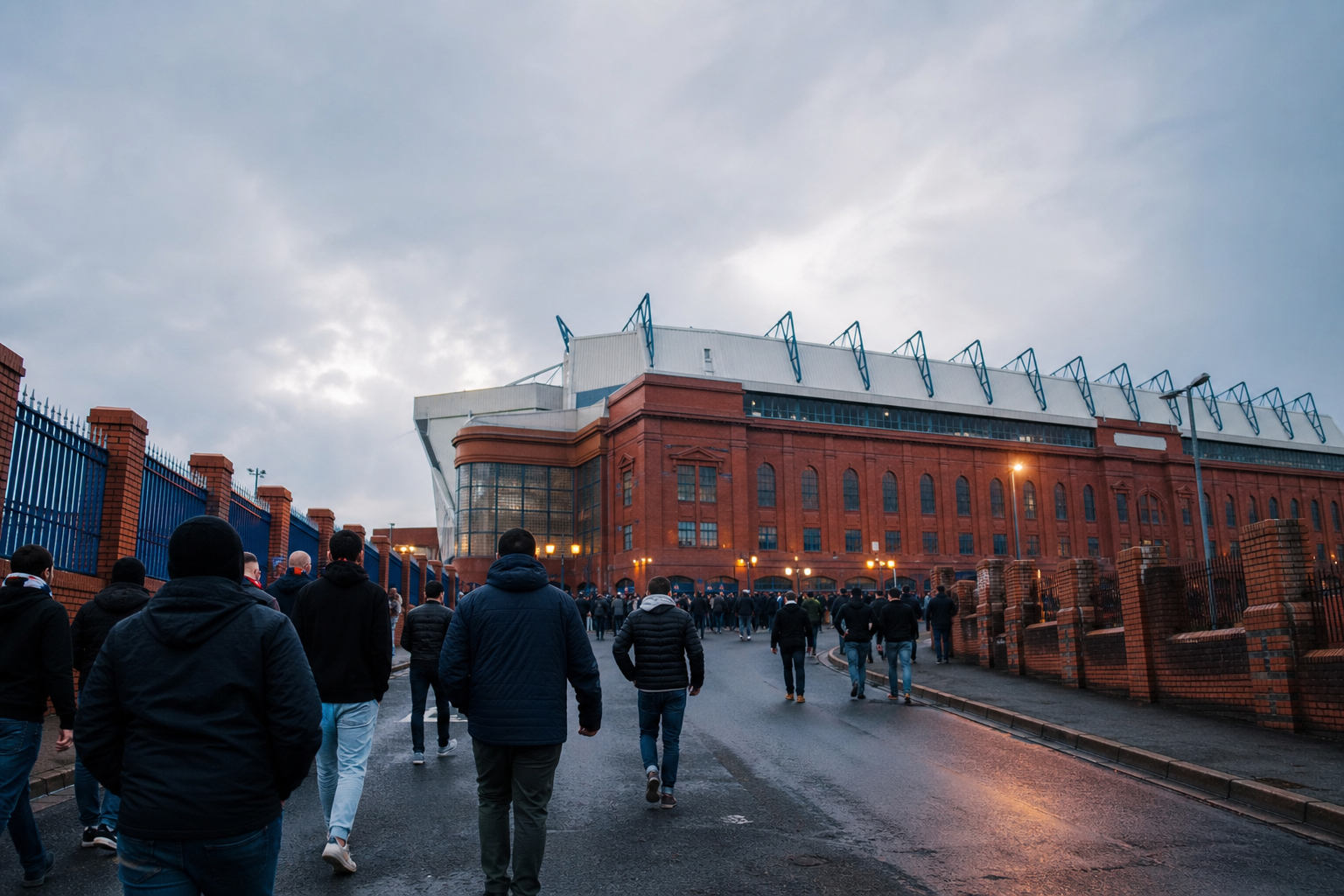
Route 6: The Glasgow Old Firm — Celtic Park and Ibrox
Stadiums: Celtic Park (Glasgow) + Ibrox Stadium (Glasgow) Country: Scotland League: Scottish Premiership
Glasgow is a two-club city in the most extreme sense. Celtic and Rangers do not simply share a city — they define it. Celtic Park and Ibrox are four miles apart, and catching both in a single weekend is straightforward when the fixture schedule cooperates. The Scottish Premiership runs Saturday-Sunday scheduling, and with only twelve teams in the league, home fixtures are frequent.
Getting there: Budget flights to Glasgow from most UK and European cities: £20-60 return. Glasgow is also a three-hour train ride from Edinburgh if you want to combine with a trip to Tynecastle or Easter Road.
Tickets: Regular league matches are more realistic than the Old Firm derby, but both clubs can still use membership, priority or official resale rules depending on the fixture. Check Celtic and Rangers directly before building the trip around a seat.
Transport between grounds: Glasgow bus or taxi. The two stadiums are on opposite sides of the Clyde, roughly 20 minutes apart by bus. A taxi costs about 10 GBP.
| Category | Cost |
|---|---|
| Return flight | £20-60 |
| Accommodation (2 nights) | £50-90 |
| Match tickets (2 matches) | £50-70 |
| Transport | £10-15 |
| Food and drink | £50-70 |
| Total | £180-305 |
Celtic Park on a European night is one of the great football experiences on this continent. Sixty thousand people, the pre-match "You'll Never Walk Alone," and the raw Glaswegian noise that carries across the east end of the city. Ibrox has a different energy — sharper, more combative — and the two grounds together give you the full spectrum of Scottish football culture.
Route 7: The Belgian Triangle — Brussels, Bruges, and Ghent
Stadiums: Lotto Park (Brussels) + Jan Breydelstadion (Bruges) + Ghelamco Arena (Ghent) Country: Belgium League: Pro League
Belgium is the most underrated groundhopping country in Europe. The Pro League has excellent atmospheres, cheap tickets, and a geography so compact that you can hit three stadiums in three different cities without ever spending more than an hour on a train. Anderlecht in Brussels, Club Brugge in Bruges, and KAA Gent in Ghent form a triangle where each city is 30-55 minutes from the others by Belgian Rail.
Getting there: Budget flights to Brussels Charleroi or Brussels Airport: £20-50 return. Eurostar from London to Brussels takes two hours if you prefer rail.
Tickets: Pro League tickets are remarkably affordable. Anderlecht: 15-30 EUR. Club Brugge: 20-35 EUR. Gent: 15-25 EUR. The Ghelamco Arena in Ghent is modern and impressive for its size, while the Jan Breydelstadion in Bruges has the atmosphere of a ground where every fan knows every song.
Transport between grounds: Belgian Rail (SNCB/NMBS) runs frequent trains between all three cities. Brussels to Bruges: 14 EUR, 60 minutes. Brussels to Ghent: 10 EUR, 35 minutes. Bruges to Ghent: 7 EUR, 25 minutes.
| Category | Cost |
|---|---|
| Return flight (or Eurostar) | £20-80 |
| Accommodation (2 nights) | £60-100 |
| Match tickets (2-3 matches) | £30-60 |
| Transport | £15-25 |
| Food and drink | £40-60 |
| Total | £165-325 |
Bruges alone is worth the trip as a city. Adding football to a Bruges weekend — walking the medieval streets, drinking a Trappist beer, then watching Club Brugge play under floodlights — is one of the more civilised groundhopping experiences available.
Route 8: The Lisbon Double — Luz and Jose Alvalade
Stadiums: Estadio da Luz (Lisbon) + Estadio Jose Alvalade (Lisbon) Country: Portugal League: Primeira Liga
Lisbon is a city built for football weekends. Benfica and Sporting CP both play in the capital, their stadiums are a ten-minute metro ride apart, and Portuguese fixture scheduling routinely puts one on Saturday and the other on Sunday. The Estadio da Luz holds 65,000 and fills with a noise that echoes off the steep upper tiers. Jose Alvalade is more compact at 50,000 but equally intense, with Sporting's ultras producing a choreographed atmosphere that belies the club's sometimes inconsistent form.
Getting there: Budget flights to Lisbon: £30-60 return. Lisbon Airport is inside the city — you can be in the centre within 20 minutes of landing by metro.
Tickets: Regular Primeira Liga matches are usually more approachable than a Lisbon derby, but use the official club channels and avoid assuming every fixture reaches general sale.
Transport between grounds: Lisbon Metro. Estadio da Luz: Alto dos Moinhos or Colegio Militar station. Jose Alvalade: Campo Grande station. Single journey: 1.50 EUR.
| Category | Cost |
|---|---|
| Return flight | £30-60 |
| Accommodation (2 nights) | £50-80 |
| Match tickets (2 matches) | £25-60 |
| Transport | £10-15 |
| Food and drink | £40-60 |
| Total | £155-275 |
Lisbon has the best food-to-cost ratio of any major football city in Europe. A bifana (pork sandwich) and a Super Bock outside the stadium costs a few euros. Pasteis de nata at the cafe afterwards. The city is warm, walkable, and football-obsessed in a way that makes you wonder why more groundhoppers don't start here.
Route 9: The Scandinavian Swing — Copenhagen and Malmo
Stadiums: Parken Stadium (Copenhagen) + Eleda Stadion (Malmo) Country: Denmark + Sweden Leagues: Superliga + Allsvenskan
Two countries, two leagues, one weekend — and the stadiums are 35 minutes apart by train. Copenhagen and Malmo are connected by the Oresund Bridge, and the train crossing is frequent and cheap. FC Copenhagen play at Parken (38,000 capacity), a ground with a proper Scandinavian atmosphere — choreographed tifos, constant singing, and a standing section behind the goal that produces noise well beyond what the capacity suggests. Malmo FF play at Eleda Stadion (24,000), where the atmosphere for Swedish derbies and European nights is outstanding.
Getting there: Budget flights to Copenhagen: £30-70 return. Copenhagen Airport has its own train station with direct connections to both the city centre and Malmo.
Tickets: FC Copenhagen: 120-250 DKK (16-33 EUR). Malmo FF: 150-300 SEK (13-26 EUR). Both clubs sell online without restrictions for most league matches.
Transport between grounds: Oresund train from Copenhagen to Malmo: 110-130 DKK (15-17 EUR) each way. The train takes 35 minutes. Within Copenhagen, the metro/S-tog covers everything. Within Malmo, buses run from the central station to the stadium.
| Category | Cost |
|---|---|
| Return flight | £30-70 |
| Accommodation (2 nights) | £80-130 |
| Match tickets (2 matches) | £25-50 |
| Transport (incl. Oresund crossing) | £35-50 |
| Food and drink | £60-90 |
| Total | £230-390 |
Scandinavia is more expensive than the rest of this list, but the football culture compensates. Scandinavian supporter culture is European tifo culture at its best — massive choreographies, pyrotechnics, and an intensity that surprises visitors who expect the stadiums to be as reserved as the countries' reputations suggest. The Copenhagen-Malmo axis also gives you two capital-city football cultures for the price of one short train ride.
Route 10: The French Double — Paris and Lens/Lille
Stadiums: Parc des Princes (Paris) + Stade Bollaert-Delelis (Lens) or Stade Pierre-Mauroy (Lille) Country: France League: Ligue 1
Paris to Lens is 70 minutes by TGV. Paris to Lille is 60 minutes. PSG at the Parc des Princes on Saturday evening, RC Lens at Bollaert on Sunday afternoon — that is a weekend. The Parc des Princes is an intimate 48,000-seat bowl where the Virage Auteuil produces a noise that rivals anything in France. Bollaert in Lens is a 38,000-capacity ground in a former mining town where the entire city lives and breathes football. The atmosphere at Lens is regularly cited as the best in Ligue 1, and the tickets are a fraction of what PSG charges.
Alternatively, swap Lens for Lille at the Stade Pierre-Mauroy — a 50,000-seat modern arena with a retractable pitch and a roof that traps the noise.
Getting there: Budget flights to Paris CDG or Beauvais: £25-60 return. Eurostar from London: £40-80 booked in advance.
Tickets: PSG: 40-90 EUR depending on fixture and seat. PSG tickets for league matches against mid-table opponents are available on general sale. Lens: 10-25 EUR — some of the cheapest top-flight tickets in Western Europe. Lille: 15-35 EUR.
Transport between grounds: Paris to Lens: TGV, 20-35 EUR booked in advance, 70 minutes. Paris to Lille: TGV, 15-30 EUR, 60 minutes. Paris Metro: 2.15 EUR per journey.
| Category | Cost |
|---|---|
| Return flight (or Eurostar) | £25-80 |
| Accommodation (2 nights) | £60-100 |
| Match tickets (2 matches) | £40-90 |
| Transport (TGV + local) | £25-40 |
| Food and drink | £50-70 |
| Total | £200-380 |
Lens is the hidden gem of French football. A town of 30,000 people that fills a 38,000-seat stadium every other week. The walk from the town centre to Bollaert on matchday, through streets packed with fans in red and gold, is one of the great groundhopping experiences in Europe.
The budget summary
All ten routes, side by side:
| Route | Countries | Stadiums | Budget range |
|---|---|---|---|
| Ruhr Derby Run | Germany | 2 | £210-310 |
| Milan Double | Italy | 2 | £200-360 |
| Randstad Triple | Netherlands | 2-3 | £245-405 |
| Istanbul Divide | Turkey | 2 | £125-240 |
| Madrid Double | Spain | 2 | £210-375 |
| Glasgow Old Firm | Scotland | 2 | £180-305 |
| Belgian Triangle | Belgium | 2-3 | £165-325 |
| Lisbon Double | Portugal | 2 | £155-275 |
| Scandinavian Swing | Denmark + Sweden | 2 | £230-390 |
| French Double | France | 2 | £200-380 |
The cheapest route is Istanbul at £125-240. The best value-for-atmosphere is the Ruhr run in Germany. The most underrated is Belgium. The one most likely to change your idea of what European football sounds like is Glasgow.
Planning the fixtures
The single biggest factor in making these routes work is fixture scheduling. European leagues announce fixtures 4-8 weeks in advance, and kick-off times are confirmed roughly two weeks before each matchday. The process for planning a two-stadium weekend is:
- Pick a weekend when you are free to travel.
- Check fixtures for the clubs in your chosen route. Each league publishes schedules on its official site.
- Confirm that the two (or three) matches fall on different days or at different times.
- Book flights once kick-off times are confirmed.
This sounds obvious, but the timing matters. A route that works perfectly when one club plays Saturday at 15:30 and the other plays Sunday at 14:00 falls apart if both end up on Saturday at the same time. Build in flexibility — have a backup route in case scheduling does not cooperate.
If you want the planning framework before choosing a country, use the weekend football trip planner. It breaks the route into an anchor match, a bonus match, ticket risk and transport buffers before you start booking.
Tracking your European grounds
Part of what makes groundhopping addictive is the accumulation. The first trip is about the experience. The second trip is about the experience and the number. By the fifth weekend route, you are looking at a map of Europe and counting the countries, leagues, and stadiums you have covered.
Track your grounds with Footbeen — log every match, see your stadium map fill in across the continent, and watch your stats grow across leagues, countries, and competitions. The ten routes in this guide cover stadiums in ten different countries and eight different leagues. Complete all ten and you will have visited 20+ European grounds, spanning from Glasgow to Istanbul, from Lisbon to Malmo.
That is a football CV worth having. Pick a route, check the fixtures, and book the flight.
If you are building a country count alongside your stadium list, see the football groundhopping passport challenge — a guide to tracking how many nations you have watched football in, with easy first targets and multi-country weekend ideas.
If the Netherlands is on your route, it deserves its own weekend. The Eredivisie groundhopping weekend breaks down the Amsterdam–Rotterdam–Eindhoven rail spine, and the Johan Cruijff Arena matchday guide and De Kuip matchday guide cover the two grounds you will most want to tick.
Keep reading
Start your football journey
Free · iOS & Android · match search ready when you are
 Scan with your phone