Bundesliga away days: a guide to watching football in Germany
Use regional rail without depending on one connection
Germany remains strong for multi-ground weekends, but the best route has redundancy. A direct regional corridor is more valuable than a theoretical three-match map.
For the current season, make these three checks before acting:
Choose one regional cluster.
Check the final stadium connection.
Leave a later service after the match.
Check the 2026/27 Fixture Calendar against the official competition or club.
Keep a second match visible through the Football Match Map.
Continue from use regional rail without depending on one connection with the relevant Footbeen planner only after the article has answered the immediate question.
Why Germany is the gold standard
There is a reason Germany keeps coming up whenever football fans talk about the best matchday experience on the continent. It starts with the 50+1 rule — the ownership model that requires clubs to hold a majority stake in their own voting rights, keeping ticket pricing fan-friendly and decision-making rooted in the community rather than a boardroom in another country. The result is that Bundesliga clubs genuinely compete for atmosphere rather than corporate hospitality revenue.
Then there are the prices. A standing ticket at most Bundesliga grounds costs between 15 and 25 euros. Even seated tickets rarely top 50 euros except for the biggest fixtures. Compare that with the Premier League, where 60 pounds gets you a restricted-view seat at a mid-table clash, and the value gap is absurd. German football is still priced as entertainment for working people, not a luxury product.
Standing terraces are the other thing that sets Germany apart. The Stehplatz — standing section — is the beating heart of every Bundesliga ground. The Yellow Wall at Dortmund holds 25,000 standing fans. Union Berlin's Alte Forsterei is almost entirely terraced. Standing culture means more noise, more movement, more flags, more pyro (technically illegal, frequently present), and a matchday experience that feels visceral in a way that all-seater stadiums in England simply cannot replicate.
And yes, you can drink beer in the stands. Not smuggled in, not sipped guiltily in a concourse — actual beer, bought at the kiosk, carried to your spot, drunk while watching the match. It's a small thing that changes the whole feel of a Saturday afternoon.
The grounds you can't miss
Signal Iduna Park, Dortmund
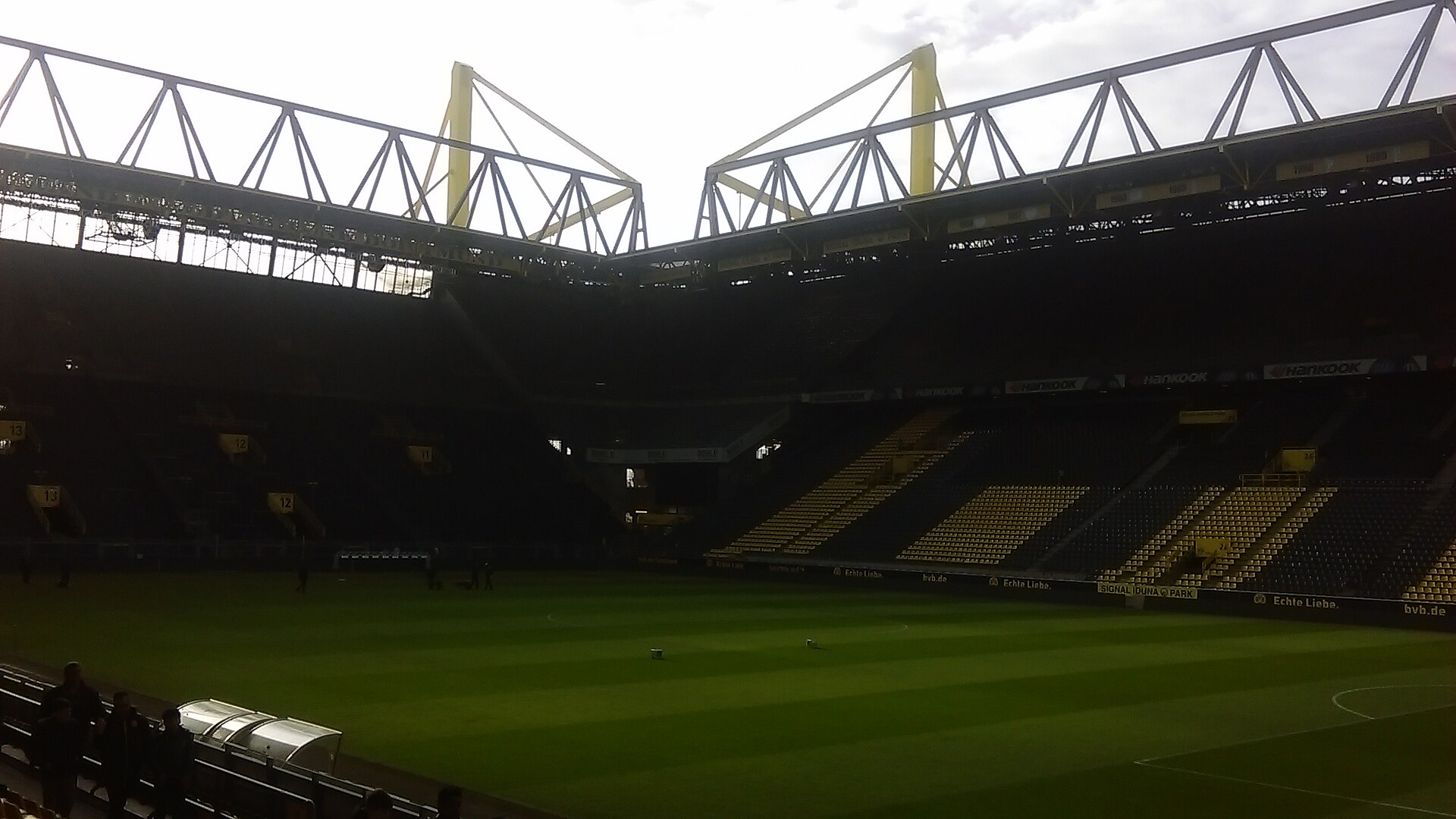
Home of Borussia Dortmund and the most famous standing terrace in world football. The Sudtribune — the Yellow Wall — fills the south end on a single rake, and when it bounces before kick-off, the noise is physical. The rest of the 81,365-capacity stadium is excellent too, but the Wall is the reason you go. Get a standing ticket if you possibly can; the seated sections feel like watching from another postcode. For entrance, transport, away-section, and ticket details, use the full Westfalenstadion matchday guide.
Allianz Arena, Munich
Bayern Munich's home is the opposite aesthetic — sleek, modern, glowing red from the outside on matchdays. The capacity is 75,000, the sightlines are impeccable, and the South Stand (Sudkurve) is where Bayern's ultras generate a wall of noise that belies the stadium's corporate sheen. The exterior architecture alone is worth the S-Bahn ride to Frottmaning. Pair it with a day in Munich and you have one of Europe's best football weekends.
Olympiastadion, Berlin
Hertha BSC's home ground is an athletics stadium, which means the running track creates distance between fans and pitch — but the history compensates. Built for the 1936 Olympics, it hosted the 2006 World Cup final and the DFB-Pokal final every year. The scale is breathtaking, the atmosphere is rawer and less polished than Munich or Dortmund, and Berlin itself turns any away day into a long weekend.
Volksparkstadion, Hamburg
Hamburger SV's ground holds 57,000 and sits in the middle of a park, giving it a setting that feels unlike any other major European stadium. The Nordtribune is a proper standing end with a fierce atmosphere, and HSV's turbulent recent history — relegation, promotion battles, chaotic ownership — means the crowd always has something to shout about. Hamburg as a city is an underrated destination: the Reeperbahn, the harbour, and a football culture that runs deep.
RheinEnergieStadion, Cologne
FC Koln's home is a modern bowl that holds 50,000, and the atmosphere is consistently among the best in the Bundesliga regardless of the team's league position. Cologne fans are famously loyal — the club sold out its season tickets in the second division — and the Sudkurve standing section is a carnival of songs, flags, and the occasional live goat (Hennes, the club mascot). The city's cathedral is a ten-minute walk from the train station, and the old town's beer halls are the perfect warm-up.
Mercedes-Benz Arena, Stuttgart
VfB Stuttgart's 60,449-capacity ground was renovated for the 2024 Euros and is now one of the best-looking stadiums in Germany. The Cannstatter Kurve — the home end — is a steep, loud standing terrace that creates an intimidating wall of red and white. Stuttgart itself is often overlooked by tourists heading to Munich or Berlin, but the Schlossplatz, the vineyards on the city's hills, and the local Swabian food make it a genuine discovery.
Getting tickets
Bundesliga tickets are cheap but not always easy to get. Most clubs sell through their own websites, and the process usually works like this: season-ticket holders have first pick, then club members (Mitglieder), then the general public. For big clubs like Dortmund and Bayern, public sale tickets for home matches sell out within minutes. For mid-table clubs — Augsburg, Bochum, Hoffenheim — you can usually buy on general sale a few weeks before the match.
If you're serious about going regularly, a Mitgliedschaft (club membership) is worth the 50-80 euros per year. It gives you priority access to tickets and, at some clubs, a small discount. For a one-off trip, your best options are targeting a less fashionable fixture (a Tuesday DFB-Pokal round, a Friday evening league game) or looking at away tickets, which are allocated separately and sometimes easier to get through the visiting club's channels.
Resale culture is minimal in Germany. For most Bundesliga clubs, the safest assumption is simple: if a match is sold out through official channels, it is sold out. Plan ahead, check ticket release dates on the club's website, and set a reminder. The prices are so low that when you do get one, it feels like a gift.
Getting around Germany
Germany's rail network is the away-day traveller's best friend. Deutsche Bahn (DB) connects every Bundesliga city, and the Deutschlandticket — the 49-euro monthly pass for all regional and local public transport — is one of the best deals in European travel. For 49 euros you get unlimited travel on every regional train, S-Bahn, U-Bahn, tram, and bus in the entire country for a calendar month. That covers the commute from the airport, the trip to the stadium, and the journey between cities if you stick to regional trains.
For longer distances — say, Hamburg to Munich — an ICE high-speed train takes about six hours and costs 30-90 euros if booked in advance via the DB Navigator app. Alternatively, string together regional trains with the Deutschlandticket and make a day of it. FlixBus connects all major cities for even less if time is not a concern.
Within cities, every Bundesliga stadium is reachable by public transport. Germans take this seriously: matchday U-Bahn and S-Bahn services run extra carriages, and the walk from station to stadium is part of the pre-match ritual. You do not need a car. You do not want a car — parking at German stadiums is limited and the post-match traffic is painful.
What it actually costs
The Bundesliga is comfortably the cheapest top-five league to attend as a fan. Here's a realistic breakdown for a weekend trip from the UK or elsewhere in Europe:
Standing ticket: 15-25 EUR
Seated ticket: 30-60 EUR
Bratwurst and a beer at the ground: 8-12 EUR
Deutschlandticket (monthly): 49 EUR (covers all local transport)
Budget hotel or hostel: 40-80 EUR per night
Return flight (London to Dortmund/Cologne/Berlin): 40-120 EUR on a budget airline
A full weekend — flights, one night, match ticket, food and transport — can realistically come in under 200 euros. Try doing that for a Premier League match at Tottenham. The value is the single biggest reason Bundesliga away days have become so popular with British, Dutch, and Scandinavian fans over the past decade.
The matchdays worth building a trip around
Not all Bundesliga fixtures are equal. These are the ones that justify booking flights the moment the schedule drops:
Revierderby — Dortmund vs Schalke: The most intense rivalry in German football. When both clubs are in the top flight, this fixture is pure hostility, noise, and emotion. The atmosphere inside Signal Iduna Park for this match is widely regarded as the best single-match experience in European club football.
Nordderby — Hamburg vs Werder Bremen: A fierce northern rivalry with decades of history. The away section at either ground is a wall of green or blue, and the mutual dislike is genuine, not manufactured.
Der Klassiker — Bayern vs Dortmund: Germany's version of El Clasico. The quality on the pitch is the highest in the league, the tactical battle is fascinating, and whichever ground it's at, the atmosphere reflects the stakes. The away end at the Allianz Arena for this fixture is something every football fan should experience once.
Cologne vs Gladbach: A Rhineland derby with proper needle. Koln fans are among the loudest in Europe, and the proximity of the two cities means the away following is always massive.
DFB-Pokal final: Held at the Olympiastadion in Berlin every May. The city turns into a football festival, both clubs' fans take over entire neighbourhoods, and the final itself has an FA Cup-style magic that league fixtures can't replicate.
Logging your German matches
A Bundesliga trip is the kind of experience you want to remember in detail — the ground, the stand, the score, the city you explored before kick-off. If you're visiting multiple stadiums across a weekend or a week-long tour, the details blur fast. Which city was the 3-1? Was Cologne the Friday night or the Saturday?
Footbeen is built for exactly this. Search the available Bundesliga and 2. Bundesliga match catalogue, confirm you were there, and keep the date, score, stadium and teams in your diary. Your Germany map fills in as you visit more cities. Your stadium count ticks up. Over time, you're not just remembering a great weekend in Dortmund — you're building a record of every ground you've stood in across the country.
Germany is the best place in Europe to fall in love with groundhopping. For a detailed breakdown of what to eat and drink at every Bundesliga ground — from the Bratwurst at Dortmund to the Rothaus beer at Freiburg — see our Bundesliga matchday food and beer guide. If Berlin is your base, use the Berlin football weekend planner before you choose between Union, Olympiastadion plans and a regional rail backup. If Dortmund is the anchor, the Ruhr football weekend guide shows how to combine Schalke, Bochum and Essen without forcing a same-day race. For a fully costed itinerary that starts in Dortmund and takes in ten stadiums across five countries for under five hundred pounds, see our budget groundhopping guide. The prices make it sustainable, the transport makes it easy, and the atmospheres make it addictive. Book the flight. Check the current regional fare. Start with the Yellow Wall.
Keep reading
Keep your football journey in Footbeen
Log the matches you attend, save every stadium and build a record that grows with every trip.
 Scan with your phone