Best football atmospheres in Europe: 10 stadiums ranked
Atmosphere needs the right fixture
A famous stadium does not guarantee its best atmosphere. Rivalry, competition, kickoff and supporter access matter, so use the ranking as a shortlist rather than a promise.
For the current season, make these three checks before acting:
Choose a fixture with context.
Check safe official ticket access.
Leave enough time for the neighbourhood before kickoff.
Check the 2026/27 Fixture Calendar against the official competition or club.
Keep a second match visible through the Football Match Map.
After choosing a fixture with the atmosphere you want, use the Football Travel Planner to organise your trip around its confirmed date.
Atmosphere is not volume
Before we rank anything, a distinction worth making: the best atmosphere is not the same as the loudest stadium. Volume matters, but atmosphere is bigger than decibels. It is the combination of noise, choreography, history, the relationship between supporters and the club, the architecture of the ground, and the feeling you carry home after the final whistle. Some of the grounds on this list are deafening. Others are intense in ways that have nothing to do with how loud the singing gets.
This is a ranking. Rankings are subjective. If your favourite ground is not here, or not high enough, that is fine — the point is to highlight ten stadiums where the matchday experience goes beyond watching football and becomes something you remember physically. These are the grounds where the hairs stand up, where the atmosphere changes how the game feels, and where neutral visitors walk out thinking about the crowd as much as the result. If atmosphere is why you travel, Footbeen's stadium map helps turn that feeling into an actual route.
For a more practical collecting angle, pair this list with the football stadium tracker, the Stadium Bucket List challenge, and the broader best stadiums in Europe bucket list. Atmosphere is subjective; logging the grounds you actually reached is not.
10. Estadio de Vallecas — Rayo Vallecano
Estadio de Vallecas, home to Rayo Vallecano, is in Vallecas in south-east Madrid. The club lists a capacity of roughly 14,000. Its location among the neighbourhood’s streets gives a visit a different setting from an out-of-town arena.
Our reason to include Rayo is the neighbourhood setting and close connection between the ground and its supporters. Matches against Real Madrid or Atletico Madrid add a city rivalry to that setting, but no fixture guarantees a particular level of noise.
When to go: Choose a confirmed home La Liga fixture. Check tickets and the final kickoff; a derby does not guarantee a particular atmosphere.
9. Stadion An der Alten Forsterei — Union Berlin
Stadion An der Alten Forsterei, the home of Union Berlin's, has 22,012 places, mostly standing. More than 2,300 volunteers contributed to its 2008–09 reconstruction. That supporter involvement is a distinctive part of the ground’s history.
The atmosphere here is powered by belonging. Union supporters feel an ownership of the ground that goes beyond metaphor: many helped renovate it. The club’s Christmas carol-singing tradition is a separate stadium event, rather than something to expect before every December home match. Check its own date, ticketing and attendance rules.
When to go: Choose a confirmed home Bundesliga game. The Christmas singing event has separate dates and ticket rules.
8. Selhurst Park — Crystal Palace
Selhurst Park is Crystal Palace's’s home in south London. The Holmesdale End is an important part of its supporter identity. We include it for the experience of a compact club ground rather than a capacity or loudness record.
At Selhurst Park, chanting, flags and the crowd’s response to the match can make a visit memorable. An evening game or a rivalry fixture is worth considering, subject to the confirmed Premier League schedule and ticket rules.
When to go: Consider a confirmed evening fixture or the Brighton rivalry, then check official ticket eligibility. Atmosphere varies from one match to another.
7. San Siro — Inter and AC Milan
Stadio Giuseppe Meazza, known universally as San Siro, is a cathedral. The third tier — the terzo anello — stands at a vertiginous angle above the pitch, and the external ramp towers that spiral around the exterior give the ground a brutalist grandeur that no modern stadium can match. Both Inter and AC Milan call it home, and on derby night, the Curva Nord and Curva Sud produce an atmosphere that ranks among the most theatrical in world football.
Flags, displays and singing can make a derby visually striking. The programme and atmosphere depend on the particular match.
San Siro's future is uncertain. Milan and Inter completed their acquisition of the stadium and surrounding site in November 2025 as part of their redevelopment project. If the ground is demolished or fundamentally altered, something irreplaceable will be lost. Visit while you can.
When to go: The Derby della Madonnina is the pinnacle. Champions League nights are extraordinary. For Serie A league matches, choose fixtures against Juventus, Napoli, or Roma for the most charged atmosphere.
6. RAMS Park — Galatasaray
Galatasaray plays at RAMS Park in Istanbul, where the club lists a capacity of 52,280. We include it for its large supporter end and the potential intensity of a major home fixture, rather than a guaranteed noise level.
Chants, flags and coordinated displays can turn a big home match into a striking spectacle. The effect depends on the fixture and the crowd that day; this guide does not claim a measured psychological or structural effect.
When to go: The Istanbul derby against Fenerbahce is a notable rivalry fixture. A confirmed European home game is another option, with ticket access and supporter restrictions checked separately.
5. Celtic Park — Celtic
Celtic Park in Glasgow holds around 60,000 spectators. We include it for the scale of the crowd and the club’s singing traditions, without claiming that every section or every fixture produces the same atmosphere.
A stadium visit is also a chance to hear songs associated with the club and see how supporters respond to the game. The impressions are personal: this ranking is an editorial selection, not a survey of players, managers or sound measurements.
When to go: Consider a confirmed European home game or the rivalry against Rangers. For any Scottish Premiership fixture, check official ticket eligibility rather than assuming neutral access.
4. Stade Velodrome — Marseille
Stade Velodrome is Olympique de Marseille’s home. Its supporter ends, displays and singing are our reasons to include it. Check the ticketed section and entry rules for your fixture.
A big game can bring strong collective reactions to goals, chances and decisions. Those changing emotions are part of football, but no visitor can book a particular mood or supporter display in advance.
When to go: A confirmed European home fixture is a strong option. Le Classique against PSG is a major domestic rivalry, but ticket availability and visiting-supporter arrangements require particular care. Choose from the actual fixture list and official sales rather than assuming any competition or match will be accessible.
3. Stadio Diego Armando Maradona — Napoli
Stadio Diego Armando Maradona, home to Napoli, was renamed in honour of Maradona in 2020. That club history makes it a distinctive stop for someone exploring Italian football.
For a Serie A trip, allow time to explore Naples as well as attending the match. Choose a confirmed Serie A fixture and check entry times; do not assume a full stadium or opening two hours early.
When to go: A confirmed home game against Roma is one option, alongside other Napoli fixtures. Choose through the official calendar and ticket rules; the ranking does not guarantee an atmosphere.
2. Anfield — Liverpool
Anfield holds around 61,000 spectators, and the minutes before kick-off on a European night can be especially memorable. When the Gerry and the Pacemakers recording of “You’ll Never Walk Alone” accompanies supporters’ singing, scarves rise across the stands and the voices from the Kop spread around the ground. It is one of the rituals that makes an Anfield visit distinctive.
Liverpool supporters respond to tackles, near misses and controversial decisions with collective reactions that change minute by minute. The Kop sings to the players and at the opposition, and the expanded Anfield Road End brings more supporters into that sound. The “Anfield factor” describes the ground’s reputation for a powerful home atmosphere; this ranking does not claim to measure its effect on match results.
When to go: Champions League knockout rounds are the peak. The Premier League match against Everton is the most charged domestic fixture. For more on visiting, see our complete guide to football in Liverpool. If you are planning a Champions League away day, Anfield on a knockout night is the fixture to target.
1. Signal Iduna Park — Borussia Dortmund
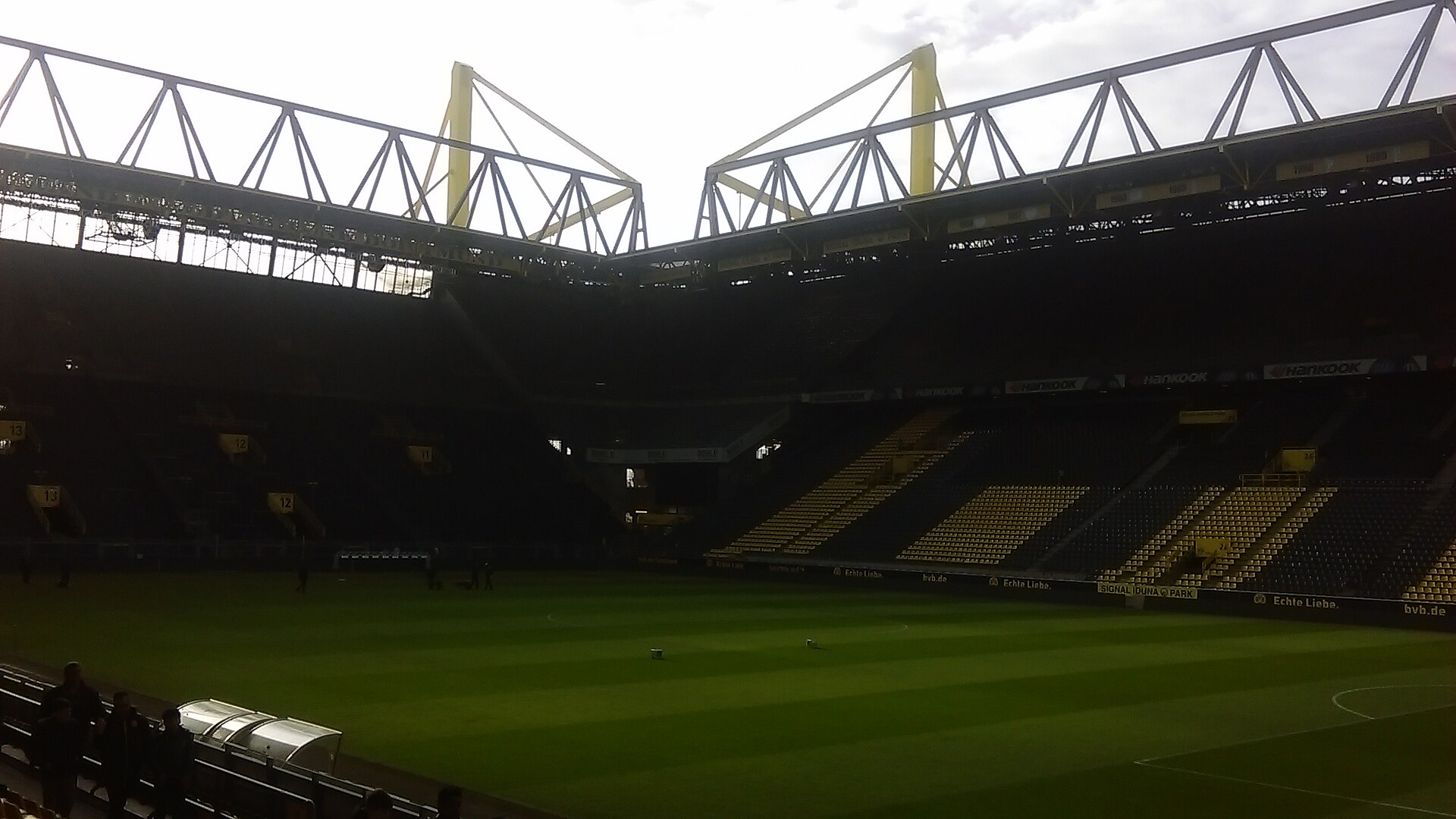
Signal Iduna Park, also known as the Westfalenstadion, has a domestic capacity of 81,365. The Yellow Wall can hold around 25,000 standing supporters. Check your fixture’s configuration, especially in European competitions.
At Dortmund, the size of the supporter end shapes the visual impression. Flags, displays and singing can make it striking; the guide does not promise uninterrupted chanting or structural vibration.
We put Dortmund first for the large standing end and strong supporter identity. This is an editorial preference, not a universal benchmark or a measured comparison with every European ground.
When to go: The Revierderby against Schalke is worth considering when it appears on the schedule. Confirm the fixture and ticket rules rather than assuming it will take place during your visit. Other Bundesliga or confirmed European home games are alternatives. For planning, see the Bundesliga away days guide.
Go and find out for yourself
Reading about atmosphere is not the same as experiencing it. You can watch clips on YouTube, listen to podcasts, and read rankings like this one, but the only way to truly understand what makes a ground special is to stand in it when the noise starts.
To combine stadium visits, use the European groundhopping weekend routes as planning ideas, the Stadium Bucket List for your own shortlist and the Football Travel Planner to find fixtures. Confirm tickets and transport before booking; each match will offer a different experience.
Track every atmosphere you experience with Footbeen — log the ground, remember the match, and build your map of European football. Free on iOS and Android.
FAQ
What is the best football atmosphere in Europe?
Dortmund is first in our subjective selection for the scale of the Yellow Wall and its supporter traditions. That is an editorial preference, not a measured universal winner.
Which stadium has the loudest football atmosphere in Europe?
This guide has no comparative decibel measurements. Dortmund, Anfield, Celtic Park, Marseille and Galatasaray are subjective suggestions; the actual experience depends on the fixture and crowd.
What is the best European stadium atmosphere for a neutral fan?
Dortmund, Napoli, Union Berlin and Marseille are our suggestions. A neutral visitor should still check ticket eligibility and the permitted section; this selection does not guarantee admission or a particular atmosphere.
Official stadium information: BVB stadium capacity; BVB south stand; Union stadium history; Galatasaray stadium facts.
Keep reading

Keep your football journey in Footbeen
Log the matches you attend and build your record of visited stadiums.
 Scan with your phone