Serie A stadium guide: every ground worth visiting in Italy
Why Italian football is worth the trip
Italy is where football becomes opera. The tactical obsession, the ultras choreography, the crumbling concrete cathedrals with views of mountains or sea — Italian football offers something no other league can replicate. The stadiums are often old, sometimes uncomfortable, occasionally half-empty for lesser fixtures. But when the big games arrive, when the curva fills and the smoke rises, there is nowhere in European football that feels more cinematic.
Serie A has also become more accessible to foreign fans in recent years. Online ticket platforms have replaced the old tabaccheria system at most clubs, budget airlines connect every major Italian city, and the country's rail network makes multi-ground trips practical. Italy rewards the football traveller who plans ahead and brings patience — because the bureaucracy is real, but so is the magic. For practical advice on securing tickets at Italian grounds, our guide to getting football tickets abroad covers the Serie A process in detail.
The grounds you must visit
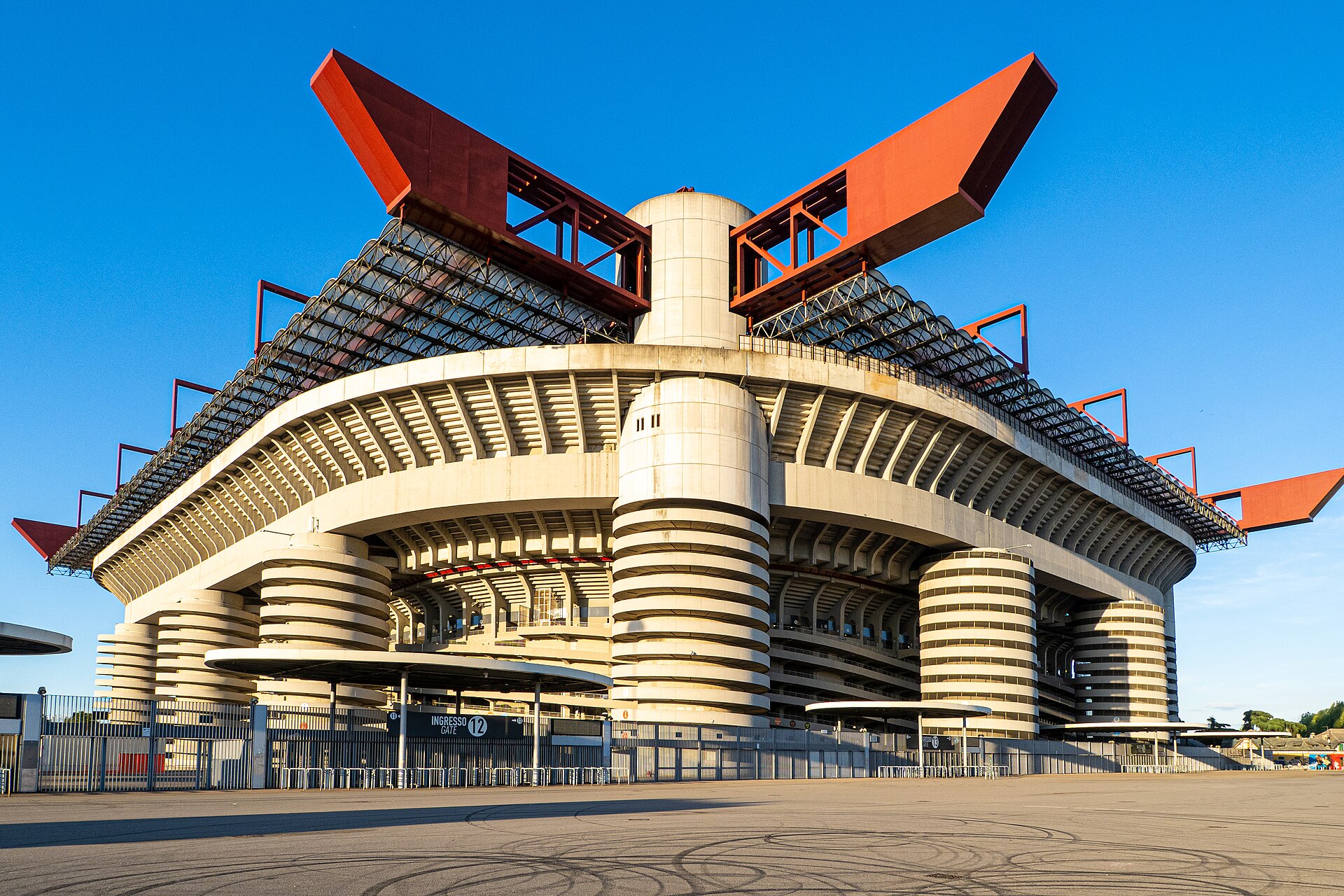
San Siro (Stadio Giuseppe Meazza), Milan
Home to both AC Milan and Inter Milan, the San Siro is the defining Italian football cathedral. The capacity of 75,817 is rarely fully tested in the league these days, but for a Milan derby or a Champions League knockout, it fills completely and the atmosphere becomes something primordial. The third tier is vertigo-inducing. The exterior towers are brutalist art. The Curva Sud (Milan) and Curva Nord (Inter) produce coordinated choreography that ranks among the best in European football.
Getting there: Metro line M5 to San Siro Stadio, or a 25-minute walk from the Lotto stop on M1. The approach through the car parks, with the stadium's towers growing larger overhead, is one of football's great walks to a ground.
Tickets: Both clubs sell online through their official platforms. Milan derbies sell out instantly via membership; regular fixtures are available on general sale 2-4 weeks before the match. Expect 30-80 EUR for a league game.
Stadio Diego Armando Maradona, Naples
Napoli's home — renamed after Maradona's death in 2020 — holds 54,726 and produces the most consistently intense atmosphere in Italian football. Neapolitans treat football as a civic religion, and the Curva B is its congregation. The stadium itself is showing its age — a 1990 World Cup venue that hasn't aged as gracefully as the San Siro — but the noise, the passion, and the city's chaotic energy make a trip to Naples unforgettable.
Getting there: Cumana train to Mostra, or Metro line 2 to Campi Flegrei then a 15-minute walk. The streets around the ground on matchday are a sensory overload of food vendors, flags, and Neapolitan intensity.
Tickets: Available through SSC Napoli's website and TicketOne. Big matches (Juventus, Milan, CL nights) sell out fast. Regular Serie A fixtures are generally available. 25-70 EUR typical range.
Allianz Stadium (Juventus Stadium), Turin
Juventus' purpose-built 41,507-seat arena opened in 2011 and remains Italy's only fully modern, all-seater, English-style ground. The sightlines are perfect, the Curva Sud is steep and loud, and the absence of a running track means the pitch feels close in a way that no other Italian ground achieves. It lacks the romantic decay of older Italian stadiums, but it delivers a consistently excellent matchday experience.
Getting there: A dedicated shuttle bus from Porta Susa station, or tram lines from central Turin. The ground sits in the Continassa area, northwest of the city centre.
Tickets: Online via Juventus' official site. Season ticket coverage is high, so availability for big fixtures is limited. Expect 40-100 EUR. Turin derbies are extremely difficult.
Stadio Olimpico, Rome
Shared by AS Roma and Lazio, the Olimpico holds 72,698 and delivers two entirely different atmospheres depending on which tenant is playing. Roma's Curva Sud is a sea of red and yellow, famous for its banners and songs. Lazio's Curva Nord is raw, intense, and historically associated with some of the most dramatic choreography in Italian football. The stadium has a running track — standard issue for Italian grounds of this era — but the scale and the setting in the Foro Italico complex, with umbrella pines visible above the stands, give it a grandeur that compensates.
Getting there: Tram 2 from Piazzale Flaminio, or a walk along the Tiber from Piazza del Popolo. The approach through the Foro Italico, past marble statues and the Mussolini-era athletics complex, is unlike anything at any other ground in world football.
Tickets: Both clubs sell online. Roma derbies are notoriously difficult; regular fixtures are usually available. 20-70 EUR. The Olimpico often has large empty sections for mid-table fixtures — choose carefully for the best atmosphere.
Stadio Artemio Franchi, Florence
Fiorentina's home is an architectural landmark — a Pier Luigi Nervi masterpiece from 1931 with a distinctive spiral ramp tower and a curved roof over the main stand that is genuinely beautiful. The capacity is 43,147, the Curva Fiesole is Fiorentina's heartbeat, and Florence as a city needs absolutely no selling as a travel destination. Football plus Renaissance art plus Tuscan food is as good as a weekend gets.
Getting there: A 20-minute walk from Santa Maria Novella station through Florence's streets. Bus lines 7 and 17 also serve the ground.
Tickets: Online via Fiorentina's website. Availability is generally good for most Serie A fixtures. 20-60 EUR.
Stadio Luigi Ferraris (Marassi), Genoa
Shared by Genoa and Sampdoria, the Ferraris is a tight, steep, covered bowl that holds 36,600 and produces one of the best atmospheres in Italian football relative to its size. The Genoa derby — the Derby della Lanterna — is one of the most hostile fixtures in European football, and even regular matches have an edge that comes from the ground's intimacy. Genoa itself is a gorgeous, underrated port city with exceptional food and a grittiness that pairs perfectly with lower-table Italian football.
Getting there: Train to Genova Brignole, then a 15-minute walk uphill along Via Canevari.
Tickets: Available locally and online. Genoa derbies require careful planning; other fixtures are accessible. 15-50 EUR.
Stadio San Nicola, Bari
A Renzo Piano-designed flying saucer in southern Italy, holding 58,270 but rarely full. The architecture is extraordinary — concrete petals that open like a flower — and Bari's fanbase is Southern Italian passion distilled. When the club is in Serie A, this becomes one of the most unique stadium experiences on the peninsula. Worth the trip for the building alone.
Getting tickets in Italy
Italian football ticketing has modernised significantly, but some quirks remain:
- Photo ID required: Most Serie A clubs require your name on the ticket to match your ID at the gate. Bring your passport.
- Away fans: Restrictions are common. Away sectors can be closed entirely for high-risk derbies, and residency requirements sometimes apply (you may need an address outside the home city to buy home tickets for certain matches).
- Fidelity cards: Some clubs (Roma, Napoli) require a tessera del tifoso or fidelity card to purchase tickets for certain fixtures. These can be ordered online but take time to arrive.
- TicketOne: Italy's dominant ticket platform handles sales for multiple clubs. Create an account in advance.
For the smoothest experience, target fixtures that are not local derbies or top-four clashes. Mid-table Serie A has exceptional football in half-empty stadiums with available tickets — and you'll often have better sightlines as a result.
Building a multi-city Italian stadium tour
Italy's rail network makes a stadium tour practical. Here's a sample five-day route:
Day 1: Milan — San Siro (Saturday 18:00 kick-off). Arrive Friday evening.
Day 2: Turin — Train from Milano Centrale (45 minutes). Juventus Stadium (Sunday 15:00). Stay overnight in Turin.
Day 3: Genoa — Train from Torino Porta Nuova (90 minutes). Explore the city, match at Marassi if fixtures align.
Day 4: Florence — Train from Genova (2 hours). Stadio Franchi if a midweek fixture; otherwise sightsee.
Day 5: Rome — Train from Firenze SMN (90 minutes). Olimpico for a Wednesday night fixture.
Trenitalia's Frecciarossa high-speed trains connect all these cities, and booking in advance on Trainline or the Trenitalia app gets you fares from 19 EUR between most destinations.
Log your Italian grounds
Italian football is the kind of journey that rewards accumulation. Each city has its own football culture, its own cuisine, its own relationship between the club and the community. Several Italian grounds also feature in our list of 20 stadiums you must visit before you die. Over time, ticking off Serie A grounds becomes a parallel way of exploring Italy itself — and a reason to visit cities (Bergamo, Udine, Lecce) that most tourists never consider.
Footbeen tracks every Serie A match, stadium, and club. Log the grounds you visit, watch your Italy map fill in, and build a record of your Italian football education. If you are planning a multi-ground trip, the Milan double is one of our top ten European weekend routes. Whether you're starting with San Siro or saving the Maradona for last, your stadium journey deserves to be remembered properly.
Italy doesn't make things easy. But it makes them beautiful.
Keep reading

Start your football journey
Free · iOS & Android · match search ready when you are
 Scan with your phone