Anfield: the complete matchday guide for visiting fans
Start with access, then build Liverpool
Anfield remains a high-demand ticket. Build the trip only after you can explain the official access route, and use Liverpool's wider football map as the backup rather than unsafe resale inventory.
For the current season, make these three checks before acting:
Verify membership and sale eligibility.
Stay flexible around broadcast movement.
Keep another Merseyside fixture in view.
Check the 2026/27 Fixture Calendar against the official competition or club.
Keep a second match visible through the Football Match Map.
Continue from start with access, then build liverpool with the relevant Footbeen planner only after the article has answered the immediate question.
Why Anfield is the trip you plan twice
Most football grounds you visit once. Anfield you visit, and then you spend the train ride home thinking about going back. The Kop is a thing your eye and your ears expect to be ordinary because you've seen it on television a thousand times — and then you stand inside the noise and realise that the camera microphone has been compressing the sound your whole life. The stand is a wall, the wall is a song, and the song does not stop for the full ninety minutes.
This is a guide for first-time visitors who do not have a Liverpool family member already telling them what to do. It is the guide we wish someone had handed us before our first visit. The factual stuff (capacity, which tube line, how the gates work) is the easy half. The harder half is what to do with the four hours before the match starts, and where to be when the city goes quiet at full-time. That's where this post lives.
A note on tickets first. This guide assumes you have a ticket already, or are coming in with the away allocation. Getting an Anfield home ticket as a non-member is the hardest single ticketing problem in English football. We've covered the realistic paths in getting football tickets abroad. For this post we'll skip ahead to the matchday itself.
Arriving in the city
Most fans arrive at Lime Street by train from elsewhere in the UK. Lime Street drops you in the centre of the city, fifteen minutes by taxi from Anfield or twenty-five by walking + bus. From the station:
- By train + walk: there is no direct train to the ground. Take the Merseyrail Northern Line to Sandhills, then walk twenty minutes through Walton up Walton Lane to the Anfield Road End. The walk is the trip — you'll join the crowd by the time you cross the ring road, and the build-up by the time you can see the floodlights is part of why you came.
- By bus: the 17, 17A, 17C and 217 all run from outside Lime Street to Anfield. They are full from about an hour before kickoff and queue down the road afterward.
- By taxi: the easy option. Black-cab or Uber from Lime Street is £8–14 depending on traffic. Don't try this in the last forty-five minutes before kickoff — Anfield Road and the surrounding streets close to traffic.
If you're flying in to John Lennon Airport, take the 86A bus to Liverpool Central (£3, 30 minutes), and from there the Sandhills walk-in route as above. The Manchester airport route is the train via Lime Street.
Where to be before kickoff
You have a choice between three pre-match flavours, and they're all good.
The pub crawl from the city centre
If you're already in Liverpool the night before, the natural pre-match starts in the Cavern Quarter or near the docks. Start at one of the city-centre pubs (the Sandon-affiliated ones in the city are reliable for matchday), then take the bus or taxi up around three hours before kickoff. This is the option for people who want to make it a long matchday. Drinking starts early, the conversation is football-only, and you arrive at the ground already in the mood.
The Anfield-area pubs
Walk up from Sandhills and stop at one of the pubs near the ground. The Sandon on Oakfield Road is the obvious one — it's where the club itself was founded in 1892, and the matchday atmosphere outside (you'll often spill onto the street with a pint) is closer to a proper European football ground than to most English ones. The Park is around the corner and quieter. The Albert and The Twelfth Man are smaller traditional locals and more home-end-only.
The chippy on Walton Breck Road has been feeding matchgoers for as long as anyone can remember and is the spiritual answer to the "I should eat something" question. Get the fish and chips, do not get the kebab, and bring cash.
The Anfield Road End walk-up
If you only have ninety minutes, skip the pub and walk the full route from Sandhills via Walton Lane. The build-up of the crowd intensifies the closer you get. By the time you cross under the railway bridge, you're inside the matchday. This is the option if you only have a half-day in the city or are flying back the same evening — you don't need pubs to get the Anfield experience.
Inside the ground — what to expect
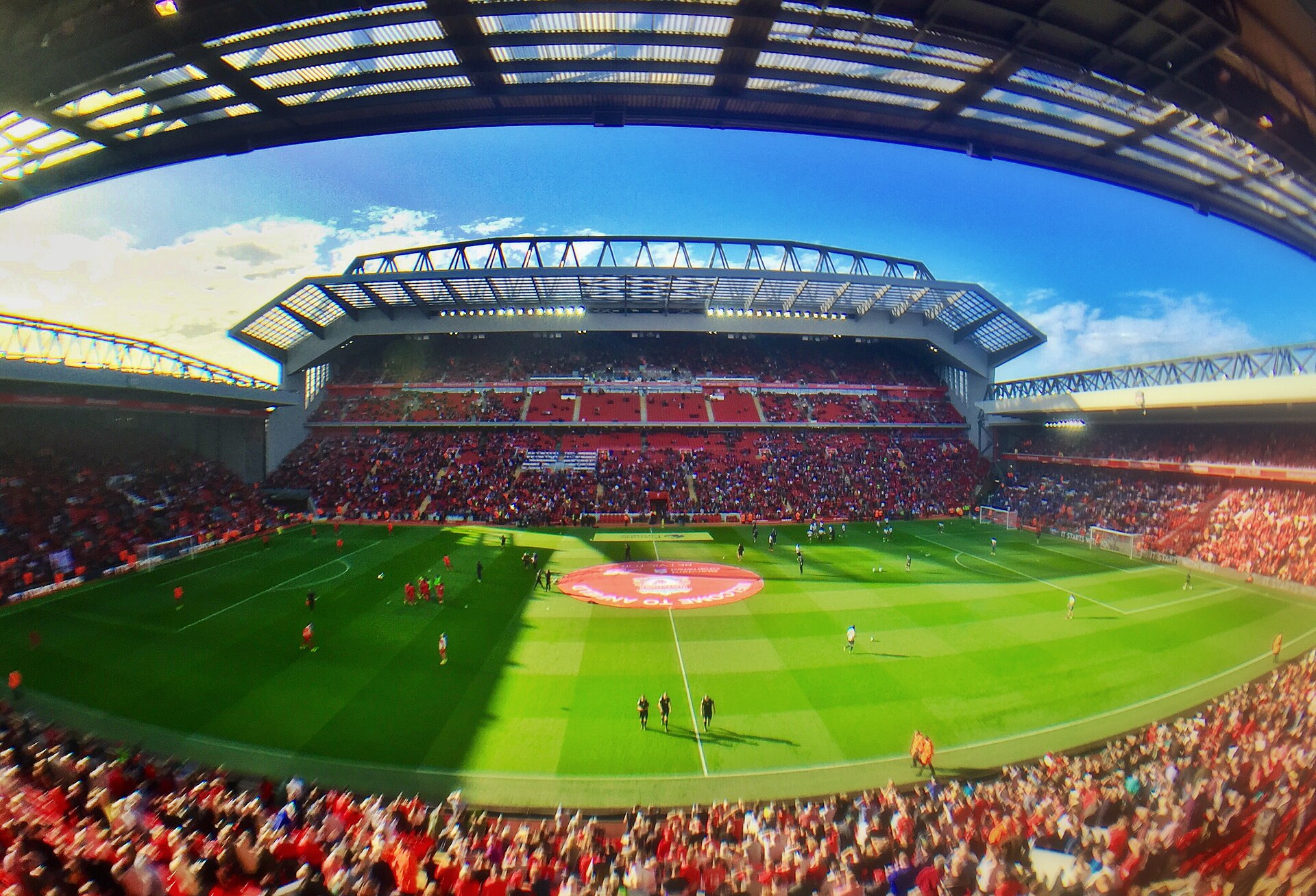
Anfield's capacity is 61,276 (post-Anfield Road End expansion, 2024). The ground is four stands joined into a continuous bowl with two large ends:
- The Kop — the famous stand. Behind one goal. The home end where the loudest singing originates. If you have a Kop ticket, get there twenty minutes early because the build-up to You'll Never Walk Alone is a thing you want to be standing for.
- The Anfield Road End — the away allocation is here, lower tier, behind the opposite goal. The expansion added a second tier above for home fans. If you're with the away support, this is your stand.
- The Main Stand — the largest single stand at any English ground. Three tiers. The middle tier is the corporate / hospitality area; the upper is the cheap seats.
- The Kenny Dalglish Stand (formerly Centenary Stand) — opposite the Main Stand, two tiers, mixed home support. Some of the best general-admission seats are here.
If you're choosing between a home-end Kop ticket and a Main Stand corner, take the Kop — the noise alone is worth more than the slightly better sightline. If you're choosing between a Main Stand corner and a high upper tier, take the corner — the upper-tier sightline is fine, but you lose the noise of being lower down.
What happens before kickoff
Anfield's matchday choreography is the most internationally-famous in club football, and it's earned the reputation. Roughly:
- Twenty minutes before kickoff: stewards start clearing the gangways. The Kop fills with banners.
- Five minutes before: lineups announced. The two club anthems play (theirs first, ours second).
- One minute before: the lights dim slightly. The first chord of You'll Never Walk Alone hits the speakers, the Kop unfurls a giant flag in red and white, and the entire ground sings. If you are not already standing, stand. If you do not know the words, hum.
- Kickoff: the ground does not sit down for the first ten minutes.
This is genuinely the most photogenic build-up in English football. Come early.
At full-time — what the city does
If Liverpool win, the city is loud for two hours. The walk back from Anfield to Sandhills takes longer than the walk in because everyone wants to be in the streets.
If they lose, the city is quiet, and the proper post-match move is a pint somewhere small and warm. The pubs near the ground close their doors faster than you'd think. Get back to the city centre before nine and you'll find what you need.
The natural after-match base is the Baltic Triangle or the Royal Albert Dock for food and drinks. Both are walkable from the city centre. If you're doing a multi-day trip, save the Cavern and the Beatles tourism for the next morning — it's cheaper and quieter before noon.
What you actually need to bring
A short checklist that we'd hand to a friend:
- Ticket in your phone wallet AND a printed backup. Anfield gates take both, but the printed version is your safety net when phone batteries die in the cold.
- ID matching the ticket name for away allocations. Home tickets are less strict but bring it anyway.
- Cash — about £30. Most matchday food and the chippy still take cash only.
- A jacket warmer than you think you need. Even in April, the Anfield Road End in the second half is colder than the city centre because of the way the wind cuts in.
- A scarf, and not a Liverpool scarf if you're an away fan. Wear your colours where it makes sense and don't where it doesn't.
What we did not cover
Catering hospitality (Box, Diamond Box, etc.) — separate league and not relevant for a first visit. Anfield Stadium Tour (do this on a non-matchday — book separately). The LFC museum (separate ticket). The new Anfield Road End hospitality offerings (still being benchmarked). Any of this we'll come back to in dedicated posts.
For the wider Liverpool football story — including Goodison on the other side of Stanley Park and the rivalry that defines Mersey football — start there. For Premier League stadium ranking overall, Anfield is at or near the top of every honest list.
If you have a fixture booked already and you're reading this in the week before — book the Sunday morning train back, not the Saturday night one. You'll thank yourself.
Track every Anfield match you've attended in Footbeen — your matchday journal, your stadium map, your record of every goal you've watched live. Free on iOS and Android.
Keep reading

Keep your football journey in Footbeen
Log the matches you attend, save every stadium and build a record that grows with every trip.
 Scan with your phone