Champions League final stadiums 2026-2030: venues and 2030 status
The new season changes the planning horizon
The 2027 Madrid final is now the next confirmed final trip, while the 2028 and 2029 host decisions remain future official milestones. Readers should distinguish confirmed venues from bidding interest before booking.
For the current season, make these three checks before acting:
Use the confirmed 2027 date as the only current booking anchor.
Treat 2028–2030 as watchlist entries until UEFA publishes appointments.
Track candidate stadiums without presenting speculation as confirmation.
Check the 2026/27 Fixture Calendar against the official competition or club.
Keep a second match visible through the Football Match Map.
Continue from the new season changes the planning horizon with the relevant Footbeen planner only after the article has answered the immediate question.
Why the final venue is half the trip
The Champions League final is the only fixture in football where the journey gets as much planning as the match itself. Tickets are a lottery — most fans go without a guaranteed seat and watch in the host city's fan zone. The host city is the trip. The stadium decides whether you're spending matchday on a U-Bahn or a tube or a tram.
This is a pragmatic guide to every confirmed and bidding final venue from 2026 to 2030. We've covered the stadium itself, the bit of the city you'll be in, what the fan zone has historically looked like at this venue, and what to expect on the day. If you are building your own final-ground watchlist, Footbeen's stadium tracker and stadium map are the easiest way to keep confirmed venues, maybes and places you've already visited in one view.
Puskás Aréna staged the 2026 final in Budapest, and UEFA has appointed Estadio Metropolitano in Madrid for the 2027 final on Saturday 5 June 2027. The 2028 and 2029 finals are still awaiting host appointments: declarations of interest were non-binding, the final bid-dossier deadline was 10 June 2026, and UEFA expects its Executive Committee to appoint hosts in September 2026. The 2030 Champions League final stadium is not confirmed yet. We'll update this post when UEFA announces a host.
For focused planning, use the new Champions League Final 2027 Madrid guide and Madrid travel article. If you are here for the exact 2030 query, go straight to Champions League Final 2030 venue.
2026 — Puskás Aréna, Budapest
Puskás Aréna is the rebuilt national stadium of Hungary, opened in 2019 on the site of the old Népstadion. It staged the 2026 final between Paris Saint-Germain and Arsenal; use our Champions League Final 2026 guide for the archived matchup, venue and Budapest planning context. Capacity for the final: 67,000.
What the city does well: Budapest is the cheapest of the recent CL final hosts, and the most under-rated. The stadium is on the Pest side, three Metro stops from the city centre. The thermal baths are a genuinely good post-match wind-down at 1am after the final whistle.
What to know about the venue: Puskás is round, two-tier, fully covered. Sightlines are excellent everywhere. The away end allocation is the upper tier behind one goal — same as Wembley. UEFA's pre-match build-up zone has historically been at Heroes' Square, twenty minutes' walk away.
Ticket reality: use UEFA's official ballot and finalist-club allocations when they open. Do not build a final trip around an informal resale offer; ticket, transfer and identity rules can change for each final.
Bring layers. Late-May Budapest can be 28°C at kickoff and 12°C by the time you walk out.
2027 — Estadio Metropolitano, Madrid
UEFA has appointed Estadio Metropolitano in Madrid as the host stadium for the 2027 Champions League final, scheduled for Saturday 5 June 2027. The ground is Atletico Madrid's modern home in the east of the city, built for big European nights and already familiar to UEFA final logistics after hosting the 2019 final. Capacity for club matches is around 70,000.
What the city does well: Madrid is one of the easiest major football cities to build a final weekend around. The centre gives travelling fans enough plazas, bars and late-night transport to spread out, while the stadium sits on the Metro network rather than in a remote event park. It is not as walkable from the centre as older Madrid grounds, but it is straightforward by public transport.
What to know about the venue: Metropolitano is a modern bowl with a dramatic roof and strong sightlines. It does not have the old-city romance of the Bernabeu or Vicente Calderon, but it is built to process large crowds and stage finals cleanly. For a neutral, the best part is Madrid itself: two huge clubs, an easy food-and-transport weekend, and enough football places to make the trip work even without a ticket.
Ticket reality: still brutal. UEFA final tickets are scarce in every host city. Treat the official ballot and finalist-club allocations as the only safe routes, and plan the city weekend on the assumption you may end up watching in an official fan zone rather than inside the stadium.
2028 — Munich bid: Fußball Arena München
The 2028 Champions League final host is not confirmed. UEFA lists Germany, Munich and Fußball Arena München as an interested bidder for the 2028 final. That declaration was non-binding; final bid dossiers were due by 10 June 2026 and the host appointment is expected in September 2026.
Fußball Arena München, still known to many fans as Allianz Arena, is the inflatable-cushion-clad rhomboid that lights up red, white, or blue depending on whose night it is. If Munich wins the 2028 bid, it will glow in UEFA blue for the final. Capacity in Champions League configuration is around 75,000.
What the city does well: Munich does logistics and beer, and we mean it as a compliment. The U6 line runs straight to the Fröttmaning U-Bahn stop next to the arena, every two minutes on matchday. Marienplatz is the natural pre-match meeting point and the city pours into the Hofbräuhaus and its surrounding Biergartens from about 4pm.
What to know about the venue: the architecture is one of the most photographed in modern European football for a reason. The walk from the stadium back to the U-Bahn after a final would be a thirty-minute crowd shuffle, so plan to either be first out or wait for the queue to clear.
Ticket reality: if Munich is appointed, expect extreme oversubscription. Apply through UEFA when the official process opens, then plan the trip on the assumption you do not get a ticket.
2029 — Wembley vs Camp Nou bidding picture
The 2029 Champions League final host is also not confirmed. UEFA lists two non-binding interested bidders: England, London, Wembley Stadium, and Spain, Barcelona, Camp Nou. Final bid dossiers were due on 10 June 2026, with the host appointment expected in September 2026.
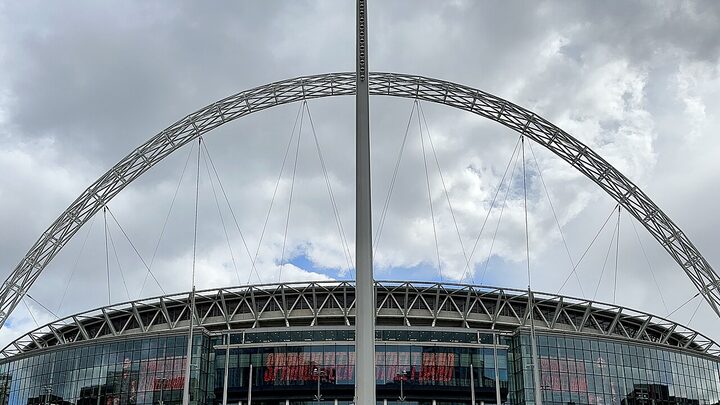
If Wembley wins, the 90,000-capacity national stadium gives UEFA the largest UK final platform and a proven event operation. London does pre-match pubs and rail capacity well, but the unofficial market is expensive and matchday around Wembley can feel functional rather than romantic.
If Camp Nou wins, Barcelona becomes the more romantic football trip. The stadium is mid-renovation, with FC Barcelona's recent temporary spell at the Estadi Olímpic Lluís Companys part of the transition. By 2029, the rebuilt Camp Nou is intended to be one of the largest club stadiums in Europe again.
What to know about the bidding picture: do not book based on assumptions. Wembley is the safest operational choice; Camp Nou is the most dramatic stadium story. Until UEFA appoints the host, both should be treated as candidates, not confirmed venues.
Ticket reality: either option will be over-subscribed. The official UEFA ballot and finalist-club allocations remain the honest routes.
2030 Champions League final stadium — not confirmed yet
The 2030 Champions League final stadium has not been confirmed. If you are searching for "2030 Champions League final stadium", "2030 UCL final venue", or "Champions League final 2030 venue", the official answer is: UEFA has not announced the host yet.
What we know now: UEFA is still working through the 2028 and 2029 host process. The 2030 final sits beyond that cycle. Heavyweight final-ready stadiums such as Stade de France in Paris, the Olimpico in Rome, Wembley Stadium in London, Munich's Allianz Arena / Fußball Arena München and Istanbul's Atatürk Olympic Stadium are always plausible in public discussion, but none of them is the confirmed 2030 UCL final venue or stadium.
For planning, treat 2030 as a watchlist rather than a booking trigger. Add the candidate stadiums you have already visited to your Footbeen stadium map, keep the unvisited ones on your groundhopping list, and wait for the UEFA announcement before committing flights or hotels.
We'll update this section when UEFA confirms the 2030 host.
If you need a page to send someone who only asks "where is the 2030 final?", use the standalone Champions League Final 2030 venue explainer. It keeps the answer short while this article tracks the full 2026-2030 venue picture.
How to plan a CL final trip without a ticket
This is the trip most fans actually take.
Book the city, not the seat. Flights and accommodation around a final spike 4× from the bidding-shortlist announcement (typically 18 months before the final) onward. If you book the moment the host is confirmed, you save real money.
Land 36 hours before. The fan zone, the open-top tour bus, the sightseeing — all of it is busier and better the day before than the day of. Final-night itself is for the match.
Pick a fan-zone over a sports bar. UEFA's official fan zone in every host city has the better atmosphere than the local Irish pub. Even if your team isn't playing, the experience is closer to the matchday inside the stadium.
Be flexible on Tuesday night. Most fans book Saturday-Saturday and miss the second-leg semi-final the previous Tuesday. If the final's host city is hosting a semi-final too, those tickets are an order of magnitude easier — and the atmosphere is often better.
Don't pay scalpers. UEFA cancels resold tickets aggressively and the fakes market ahead of recent finals has been bad. The fan-zone is the honest play.
Track every CL final you've watched
If you've been to a Champions League final — at the ground or in the host-city fan zone — log it in Footbeen. The app works as a stadium tracker, stadium map, and match diary: pin Allianz Arena, Wembley, Camp Nou, and every domestic ground you've visited on the same personal football map.
Use the football travel planner when you're choosing a host-city weekend, or the groundhopping guide if the final is one stop in a bigger trip. Your CL finals sit alongside your league grounds, countries, clubs, and match history.
See also our Champions League away-days travel guide for non-final European nights, and our guide to getting football tickets abroad for the practicalities of any away trip.
FAQ
What is the 2030 UCL final venue or stadium?
UEFA has not confirmed the 2030 UCL final venue or stadium yet. Searches for "2030 UCL final venue", "2030 UCL final stadium" and "Champions League final stadium 2030" all have the same official answer: no host has been announced.
Where is the 2027 Champions League final?
The 2027 Champions League final will be at Estadio Metropolitano in Madrid, the home of Atletico Madrid. UEFA says the final is scheduled for Saturday 5 June 2027.
Is Munich confirmed for the 2028 Champions League final?
No. Munich's Fußball Arena München is listed by UEFA as an interested bidder for the 2028 Champions League final, but the host has not been appointed yet.
What are the 2029 Champions League final candidate stadiums?
UEFA lists Wembley Stadium in London and Camp Nou in Barcelona as interested bidders for the 2029 Champions League final. The host appointment is expected after the bidding process.
What are future Champions League final venues after 2027?
The confirmed future Champions League final venues are Puskás Aréna for 2026 and Estadio Metropolitano for 2027. The 2028 and 2029 venues are still in the UEFA bidding process, and the 2030 Champions League final venue has not been announced.
Keep reading

Keep your football journey in Footbeen
Log the matches you attend, save every stadium and build a record that grows with every trip.
 Scan with your phone