De Kuip matchday guide for visiting fans
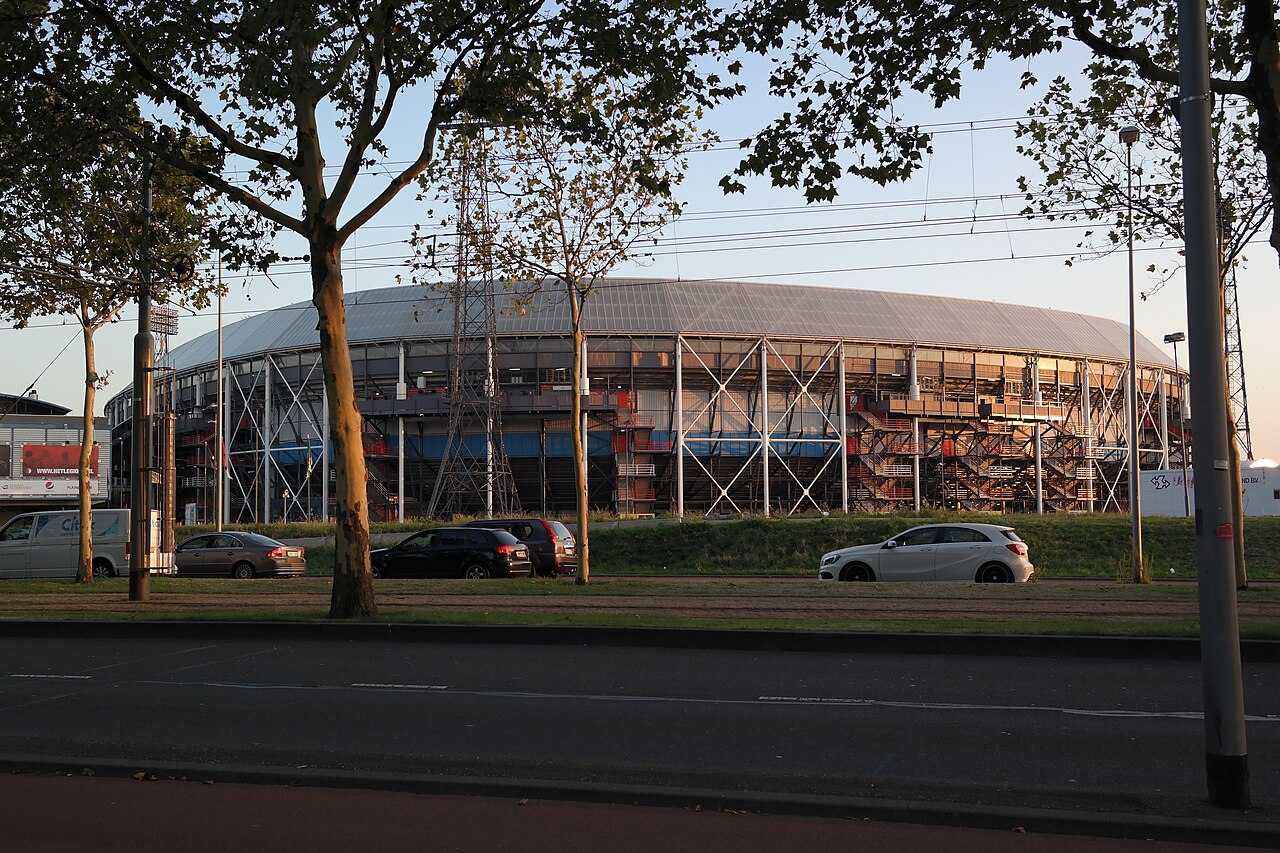
Some grounds sound louder than their capacity should allow, and De Kuip is the classic example. Feyenoord's home is a steep, near-vertical two-tier bowl opened in 1937, and on a big night the way it traps and amplifies noise is the whole point. Rotterdam fans do not just tolerate the old place; they love it fiercely, which is exactly why the question of a new stadium has been so complicated for so long.
This guide covers what a visiting fan actually needs for a matchday at De Kuip: how to get there, how tickets really work when you are not a member, what the ground feels like inside, and how to build a sensible trip around it. Its official name is Stadion Feijenoord, after the Rotterdam district it sits in, but everyone calls it De Kuip — Dutch for "the Tub", which makes sense the moment you see the shape.
Getting there
De Kuip sits south of the river Maas, a short hop from central Rotterdam. You do not need to overthink the journey, but the tram is the option most visitors want.
Tram from Rotterdam Centraal
From Rotterdam Centraal, tram 23 (direction Beverwaard) runs to the Stadion Feijenoord stop, which drops you close to the ground. The ride is roughly 20–25 minutes. On matchdays operator RET typically adds extra services on this corridor, so check the RET journey planner on the day for the current pattern and any matchday-only lines.
If you are already on the metro, take a line towards the city and change to the tram: metro lines D and E stop at Wilhelminaplein, where you can switch to tram 23 for the last leg. As always with a first visit, confirm the live route with RET rather than relying on a fixed line number, because matchday running can differ from the standard timetable.
One genuinely useful perk: RET has long offered free travel on its network for a window around Feyenoord home matches when you show a valid matchday ticket. This is a nice saving, but treat it as something to confirm on the RET site for your specific fixture rather than a guarantee, since these promotions can change.
Driving and parking
Driving is not the move for a visiting fan. Matchday parking around De Kuip is limited and controlled, the surrounding streets get busy, and Rotterdam's public transport is good enough that you should not need a car. Leave it at the hotel and take the tram.
How tickets work
Here is the honest version: De Kuip holds around 51,000, Feyenoord's support is huge, and the biggest fixtures sell out well before general sale. Season ticket holders and Club Card members with an attendance history get priority in the sales windows, which is standard for a club this well supported.
For a neutral visitor, that means the fixture you choose matters as much as when you buy:
- Lower-demand Eredivisie fixtures are your best bet for a general-sale ticket. A mid-table league game on a normal weekend is far more reachable than a marquee night.
- De Klassieker against Ajax, plus PSV and big European knockout nights, are the hardest tickets in the country and effectively members-first. If your heart is set on one of those, plan around hospitality or accept long odds on the open market.
- Buy through official Feyenoord channels first. If you end up looking at resale, be careful — high-demand Rotterdam fixtures are exactly where scams cluster. Run any offer through the football ticket scam checker before you pay a stranger.
- Carry ID that matches your booking. Dutch grounds increasingly tie tickets to a named holder, and Feyenoord is upgrading to modern self-scan entry gates, so your name and your ticket should line up.
A practical note on segregation: for high-profile matches the club and city apply strict crowd separation, sometimes including designated travel arrangements for away supporters. It is nothing to be nervous about — just useful to know so you follow the instructions on your ticket and enter through the correct gate.
Timing and arrival
Aim to arrive around 60–75 minutes before kick-off. That leaves room for the tram, entry checks at the gates, and finding your seat in a stadium where the climb to the upper tier takes longer than you expect. It also lets you soak up the build-up, which at De Kuip is a big part of the experience.
Feyenoord play to the standard Dutch weekend-and-evening rhythm, but kick-off times move for broadcast and European scheduling. Always confirm your own fixture's exact date and time close to the day rather than trusting an old listing.
Inside the ground
The defining feature is the steepness. Those two free-hanging tiers rise at an angle that feels almost alarming as you shuffle to your seat, and the reward is an unobstructed view straight down onto the pitch. Because the stands are close and stacked so vertically, the acoustics are superb: sound has nowhere to escape, and the roar on a big night rolls around the bowl in a way modern out-of-town arenas rarely match.
Concourses are functional rather than fancy. This is a pre-war ground kept in service, not a food-hall stadium, so grab what you need on the way in and do not expect boutique catering. The trade-off is atmosphere, and that is a trade most visitors are happy to make.
The future-of-De-Kuip question
You cannot write about De Kuip in 2026 without touching the long-running new-stadium saga. For years the club pursued a new-build (the "Feyenoord City" plan), but those proposals were shelved. More recently Feyenoord has taken ownership of the stadium itself and shifted towards renewing and potentially expanding the existing De Kuip — with talk of adding several thousand seats and a long-term programme running years into the future. As of mid-2026 none of that is finalised: no expansion is confirmed, and the club keeps playing at the current ground.
For a visiting fan the takeaway is simple and reassuring: you are going to De Kuip. But because this is a fixture-and-venue story that could evolve, confirm the venue when you buy, especially if you are booking a long way ahead.
Making it a weekend
The Netherlands is a compact, tram-and-train country, which makes it excellent for stacking football. Rotterdam pairs naturally with its neighbours, and the Eredivisie groundhopping weekend across Amsterdam, Rotterdam and Eindhoven lays out how to line up more than one match without over-committing. If you want to see how Rotterdam fits a bigger continental trip, the European groundhopping weekend routes guide is a good next read.
Amsterdam is well under an hour away by train, so combining a Feyenoord night with an Ajax fixture is realistic when the calendar cooperates — the Amsterdam football weekend planner helps there, though always check both clubs' fixtures line up before you book. Working through the Netherlands ground by ground is exactly the kind of project this rewards.
Log it in Footbeen
De Kuip is a ground that stays with you: the climb, the angle, the noise closing in from all sides. When you go, log the match in your football match diary so the visit joins your personal football journey, and add the ground to your stadium tracker map. Ticking off Europe's great old bowls one steep away end at a time is exactly what the app is built for.
Keep reading

Start your football journey
Free · iOS & Android · match search ready when you are
 Scan with your phone